Knowledge Base forRoland JP-80x0 Editor
Documentation
Resources
Roland JP-80×0 Editor – Utilities: Editor Preferences
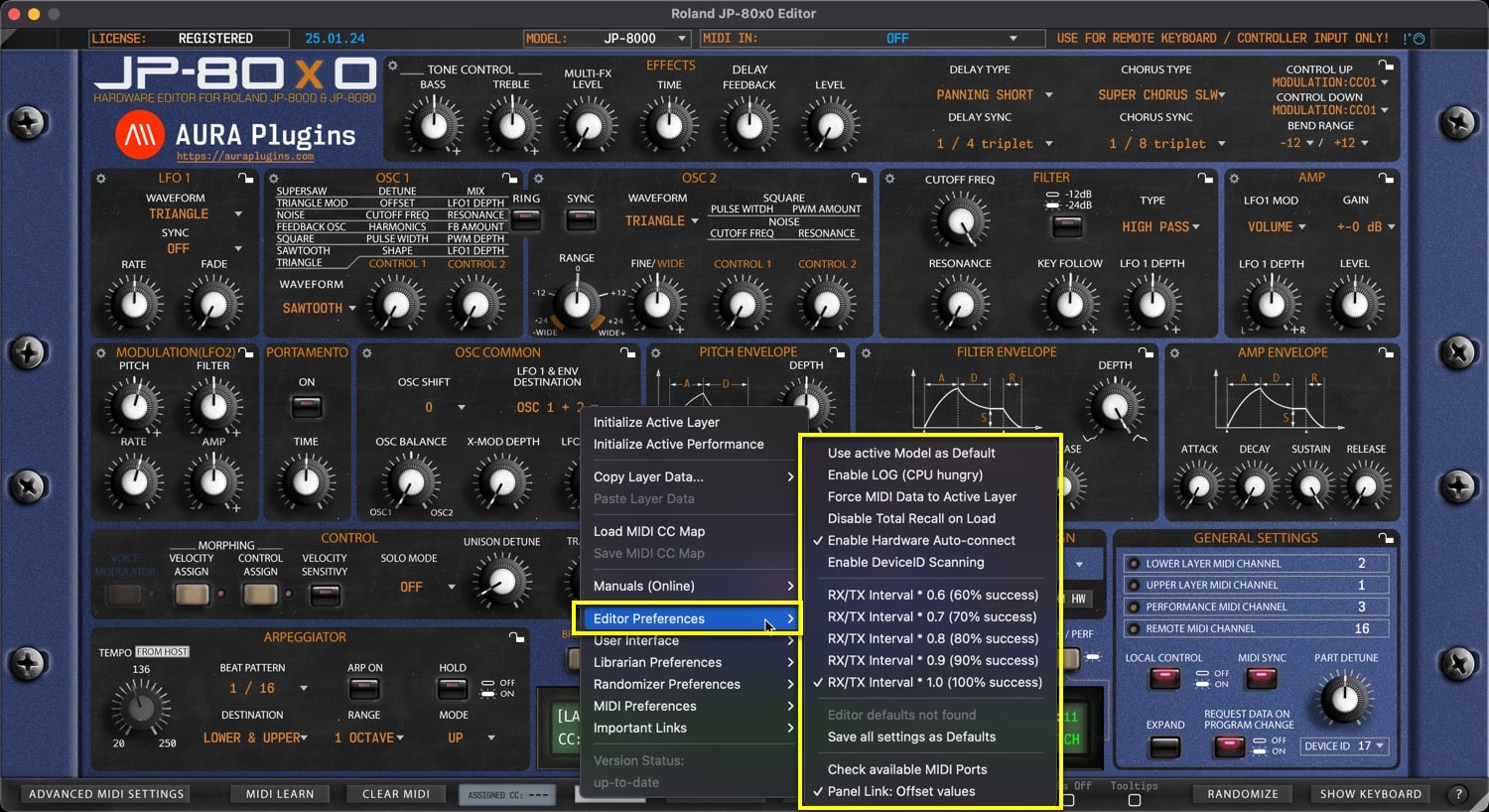
Utilities Menu – Editor Preferences Breakdown
Use active Model as Default
If you have only synth in your setup, you can toggle on “Use active Model as Default” AFTER you have chosen your model from the top row dropdown list.
This way each new instance is automatically set to specific model, ie JP-8080.
Enable LOG
If you have trouble loading the Editor, you enable the LOG function via the Roland JP-80×0 Editor PREFS.txt file found in:
~/Music/AURA Plugins/Roland JP-80x0 Editor/
Change line “log:no” to “log:yes” and line with “0” (zero) to “9000“. Save the file, close it and then re-open the Editor.
If any errors occur, open the Roland JP-80×0 Editor LOG.txt found in the same place as above, see what the last line says. If the last line is saying
“Loading bank x.mid” and log ends there, the issue is with that specific bank. Send it over to us for inspection via the ticket form and we will fix it.
Force MIDI Data to Active Layer
This function routes all incoming MIDI CC data to currently active LAYER.
This only applies while the DAW playback is OFF. If playback is toggled ON, then MIDI is routed normally from channels received.
Playback OFF: MIDI received from channel 4 is sent to currently active LAYER channel ie 2.
Playback ON: MIDI received from channel 4 is sent to hardware channel 4 (which might be unadressed).
Disable Total Recall on Load
This is handy function if you DON’T want to send Editor data to hardware upon project load. You can always manually dump the Editor data to hardware via Librarian -> Push Data to HW toggle.
Enable Hardware Auto-connect
Allow Editor to automatically connect with the hardware after MIDI in and MIDI out are set. Connection usually succeeds with 100% rate IF Device IDs match in the hardware and in the Editor.
Enable DeviceID Scanning
If enabled, it will take a bit longer for the Editor to find the hardware IF the hardware Device ID is not 17. Usually when the Editor is opened, we recommend to set Device ID, Model and then MIDI input & output ports.
Adjust Request Interval
You can manually adjust the Request interval via the menu options as follows:
0.6 (60% success) to 1.0 (100% success). Usually 100% is enough and there is no further action needed from users. Some speedy pants like to experiment with faster rates but there might be errors occuring while experimenting.
Save all settings as Defaults
Gets all the Editor MIDI I/O, Device ID and global settings and stores them as defaults.
Worth a note, if MIDI interface is not connected or if the Editor core has changed, then this option is known to cause crashes.
Check Available MIDI Ports
If you forgot to power on your MIDI device before inserting the Editor, you can rescan the MIDI ports with this function.
Panel Link: Offset values
When toggled on, all linked controls follow each others while respecting the offset they have on each other. ie, lower panel cutoff is 40 and upper if 80, now if you move cutoff down 20 steps, then lower panel is 20 and upper 60.
When toggled off, linked controls follows the adjusted control value, ie, lower is 20 and upper is 60, now if you move upper up 10 steps, both panels are set to 70.
Share this with fellow producers