Knowledge Base forAccess Virus Editor

Documentation
Resources
Access Virus TI USB Audio with Omnibus (macOS & Windows)
NOTE: Video link to setup Virus TI USB Audio with Omnibus will available shortly!
Access Virus TI USB Audio with Omnibus
We have covered macOS Native USB and Audiomovers INJECT connection with Access Virus TI, so lets jump to something different: Audiomovers Omnibus! What is Omnibus?
Omnibus is an application that lets you stack Audio devices together, just like with Apple native Aggregate Device, but this one works with macOS and Windows! There is more to it: Omnibus supports Network Audio connections with AVB (mac only) and NDI + you can build your Virtual routing as you prefer with recallable snapshots – Transfer audio between Apps & computers – with or without soundcards!
OK, let’s get into it. What do you need?
- Access Virus TI and/or Access Virus TI Snow (obviously)….
- USB cable.
- USB-C to USB 2 or USB 3 Hub.
- Access Virus Editor.
- Audiomovers Omnibus
Install our Access Virus Editor from the downloads page. Demo works too, but you are missing a lot features with it ($69.95 is a very small fee for a fully working editor)! In macOS it is important to remove the original Access Virus Control software, here is the uninstall instructions (Steps 1, 2 and 3).
NOTE: This Guide is written in macOS 12.7.6 – Windows App might be a bit different, but you’ll find the configuration is pretty much the same!
Step 1
Visit Audiomovers OMNIBUS and download the DEMO if you haven’t purchased the App yet: https://audiomovers.com/products/omnibus
Install Omnibus and Reboot if needed.
Step 2
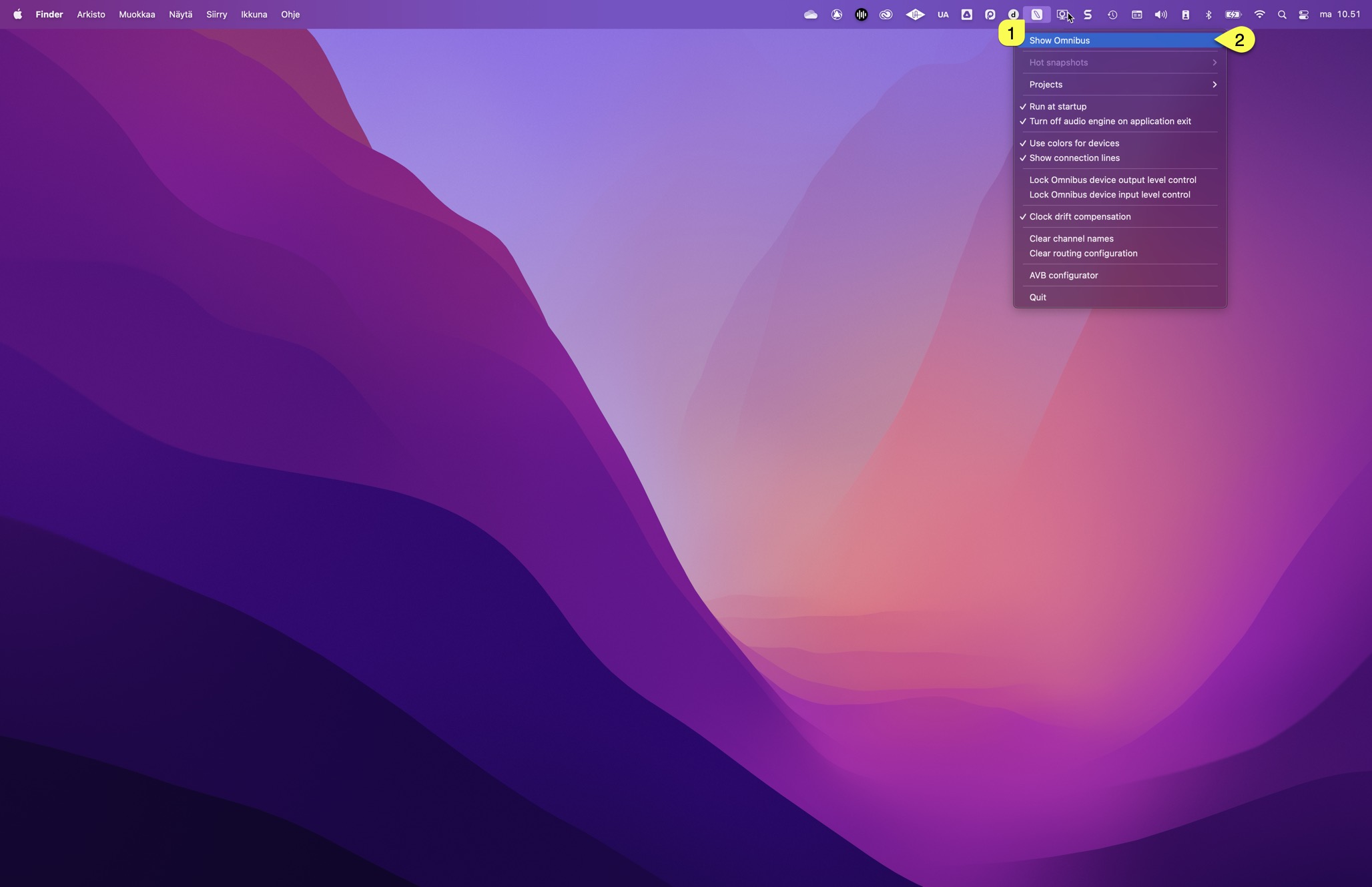
Open OMNIBUS App. On macOS you can find Omnibus.app from the Applications folder and/or from the main menu bar [1]. This will open the Omnibus menu, click Show Omnibus [2] to open the window.
Add New Virtual Device (if needed)
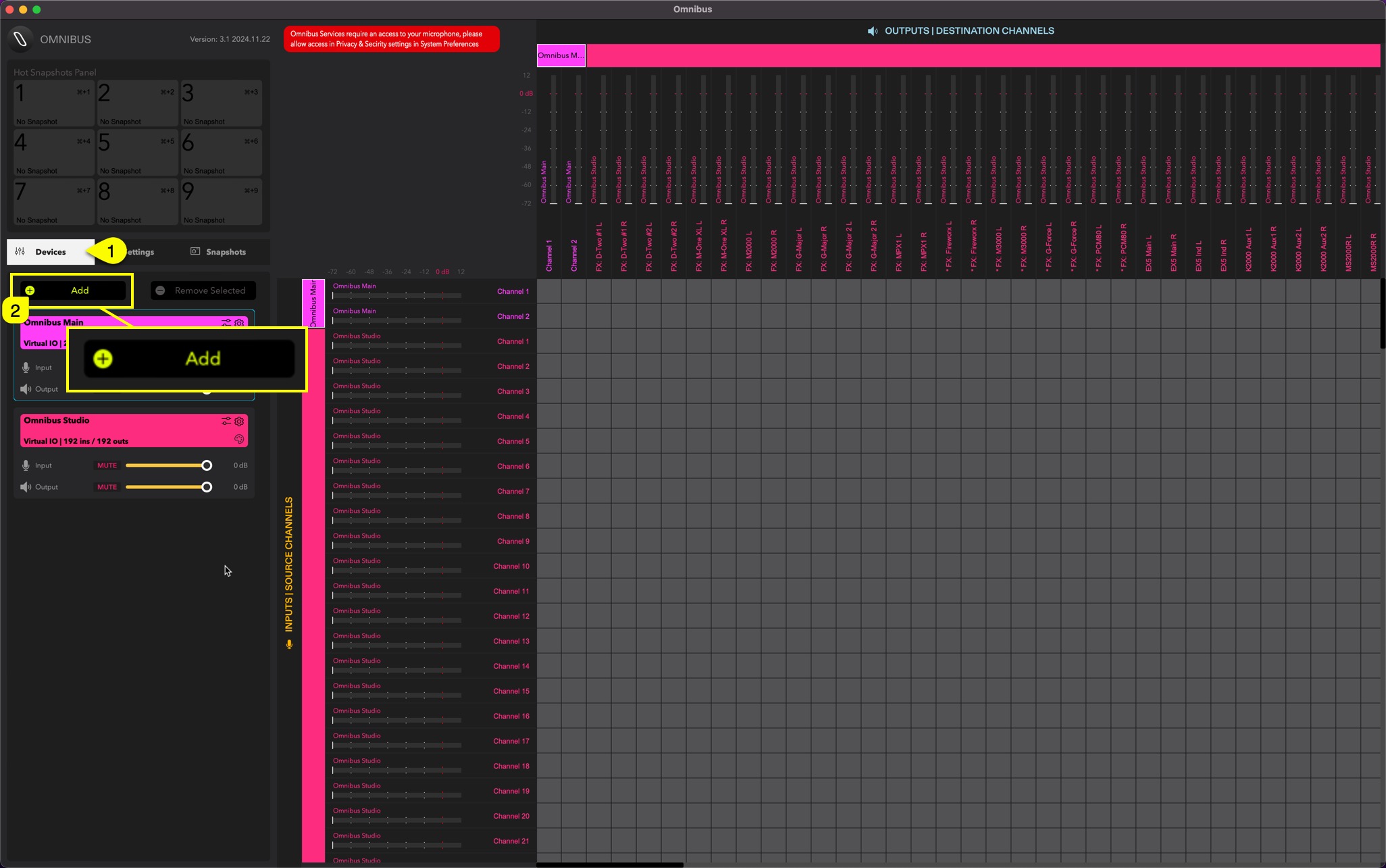
In OMNIBUS window, click Devices [1] tab, and click Add [1] to create a new Virtual Sound device.
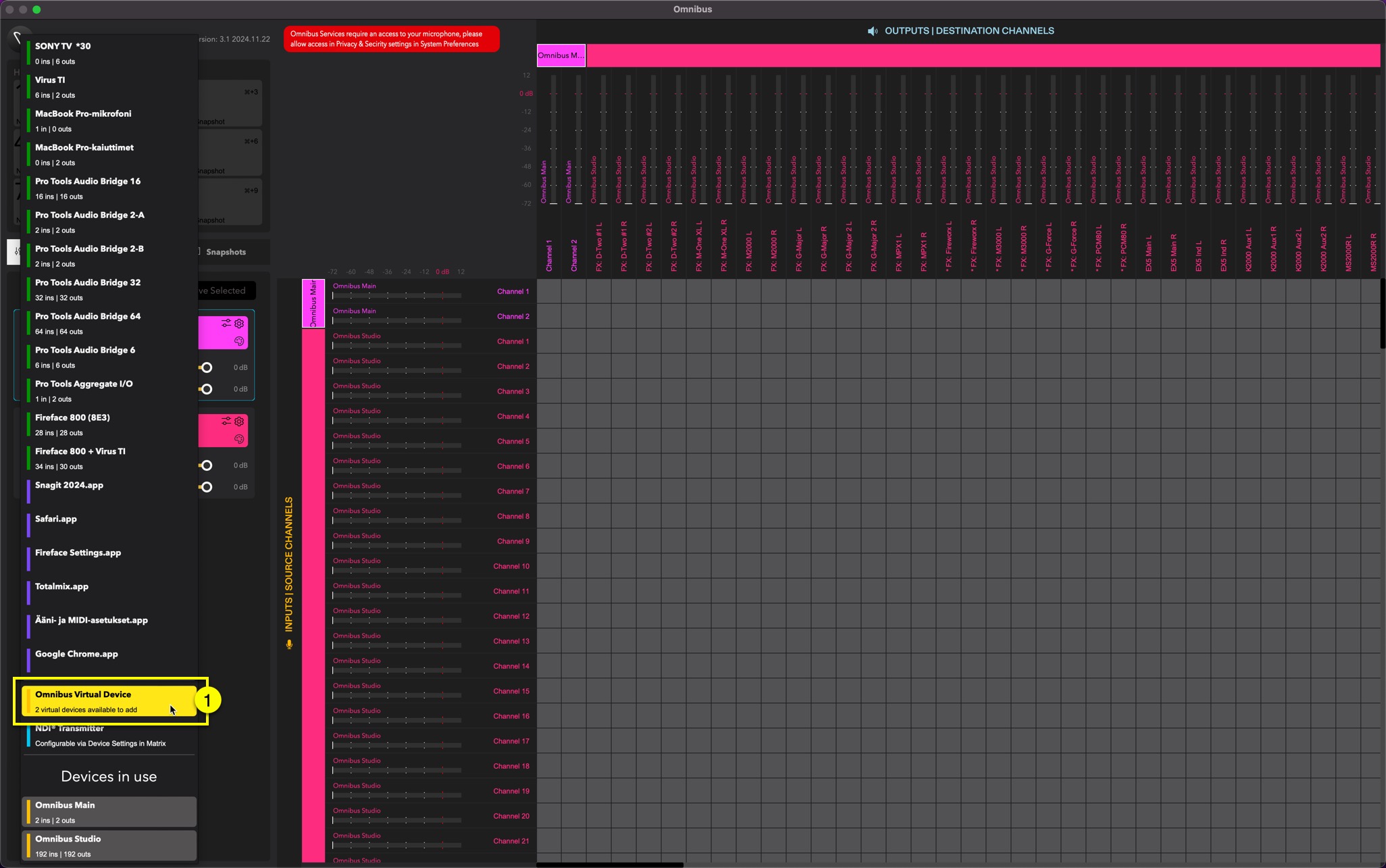
This will open a popup menu showing all Audio Devices connected and Applications available for routing. In our example, we are going to add Omnibus Virtual Device [1] first.
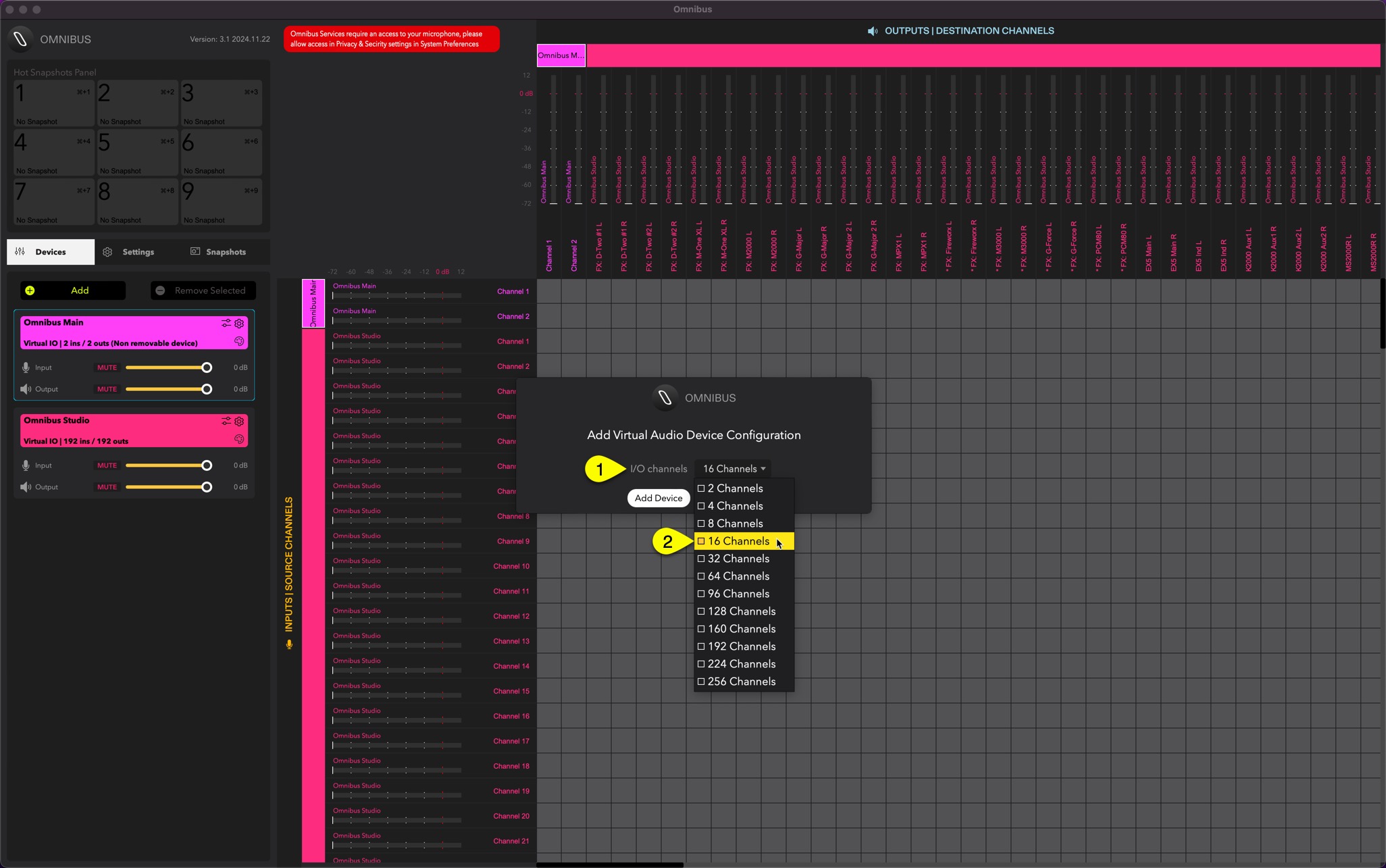
A new window will open up, prompting for I/O Channel [1] count. We are going to use 16 Channels [2] to keep the views clean. You can add as many channels you need, could be less, could be more. Click Add Device once you’ve figured out your need.
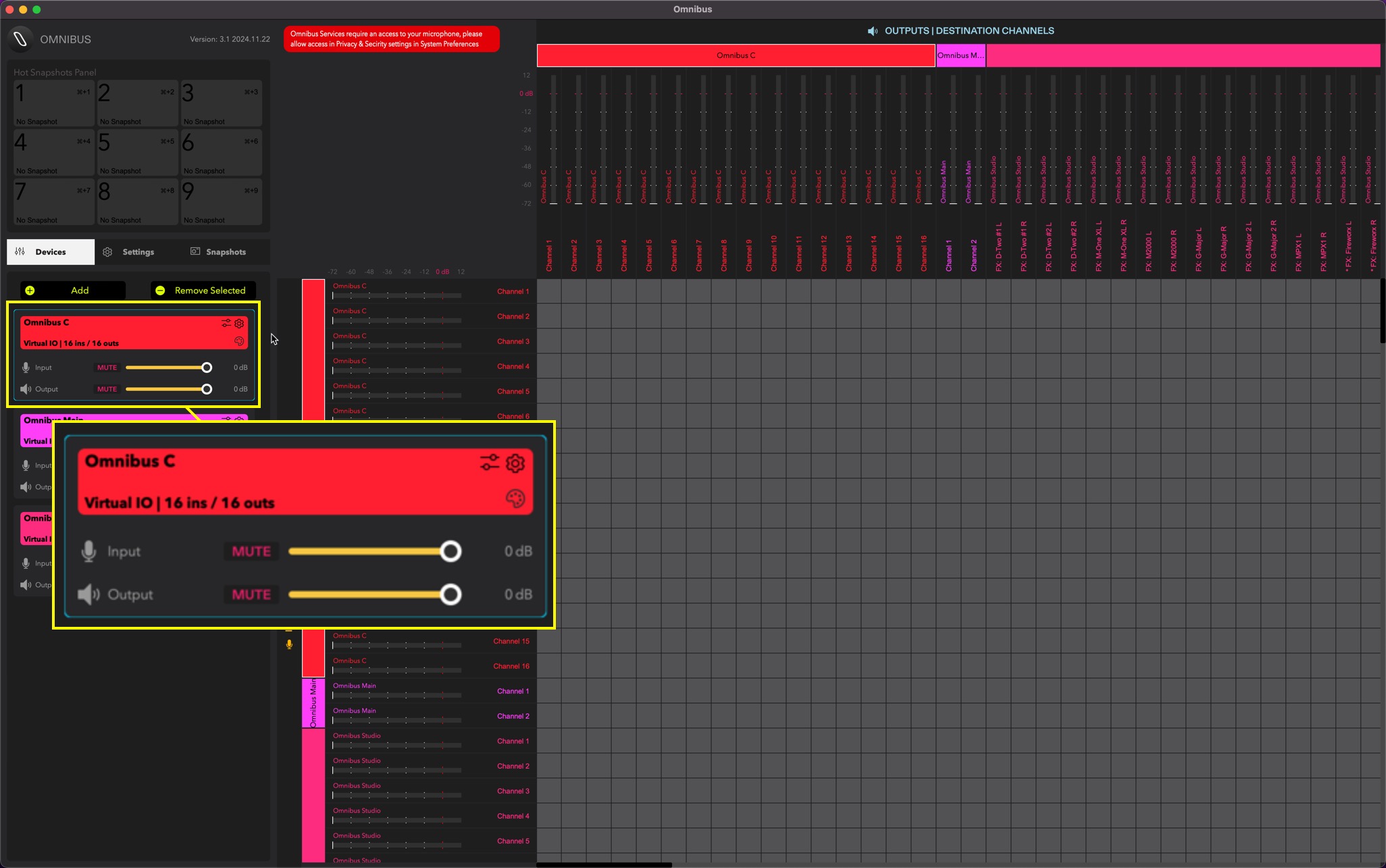
New virtual audio device is now created! Click the color palette to change the Device Color (helps while navigating in matrix view).
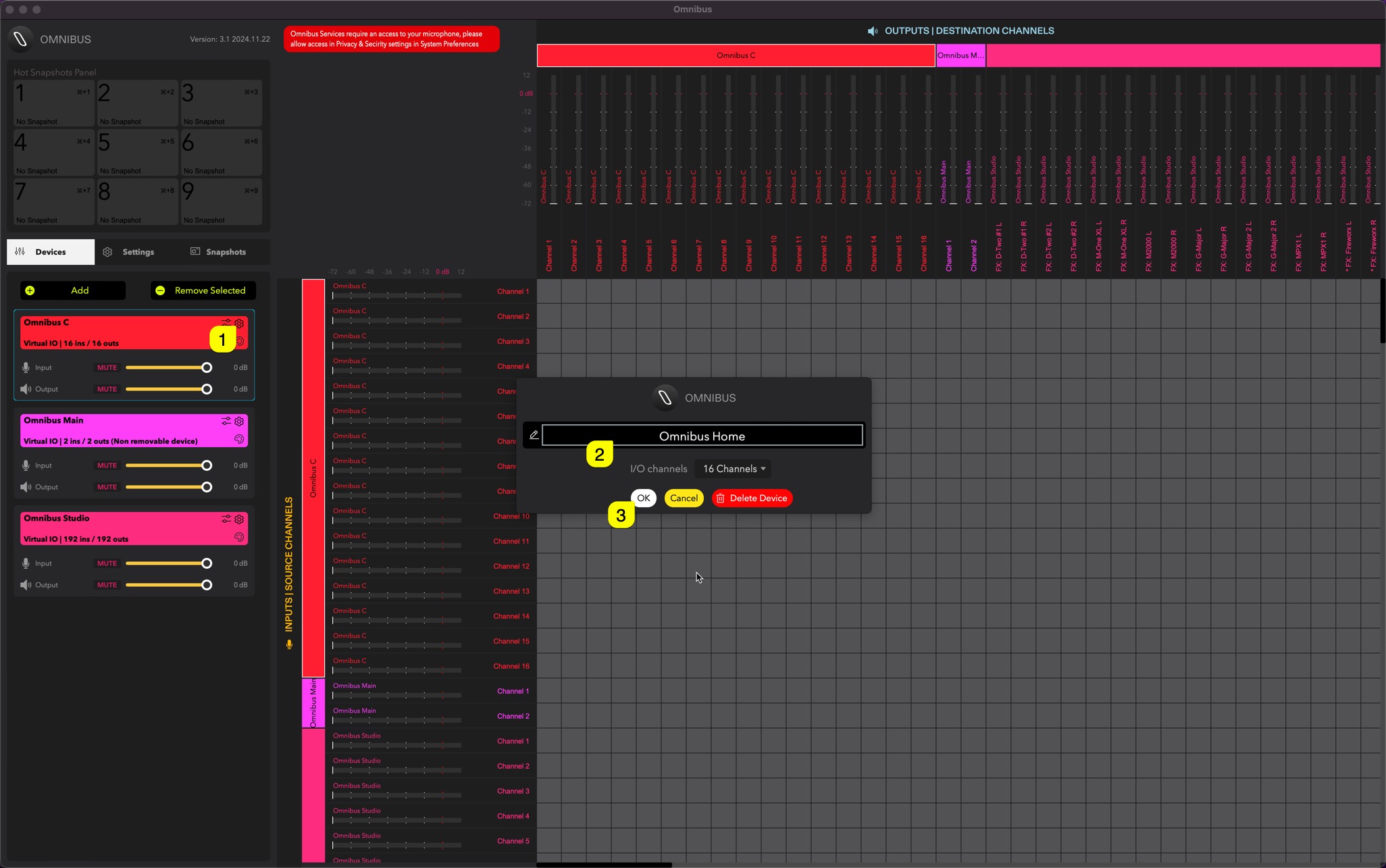
I am going to rename Omnibus C to something different. To do this, click the Gears [1] icon. You can now input a new name [2], adjust number of Channels or delete the device. Click OK [3] once you’re happy.
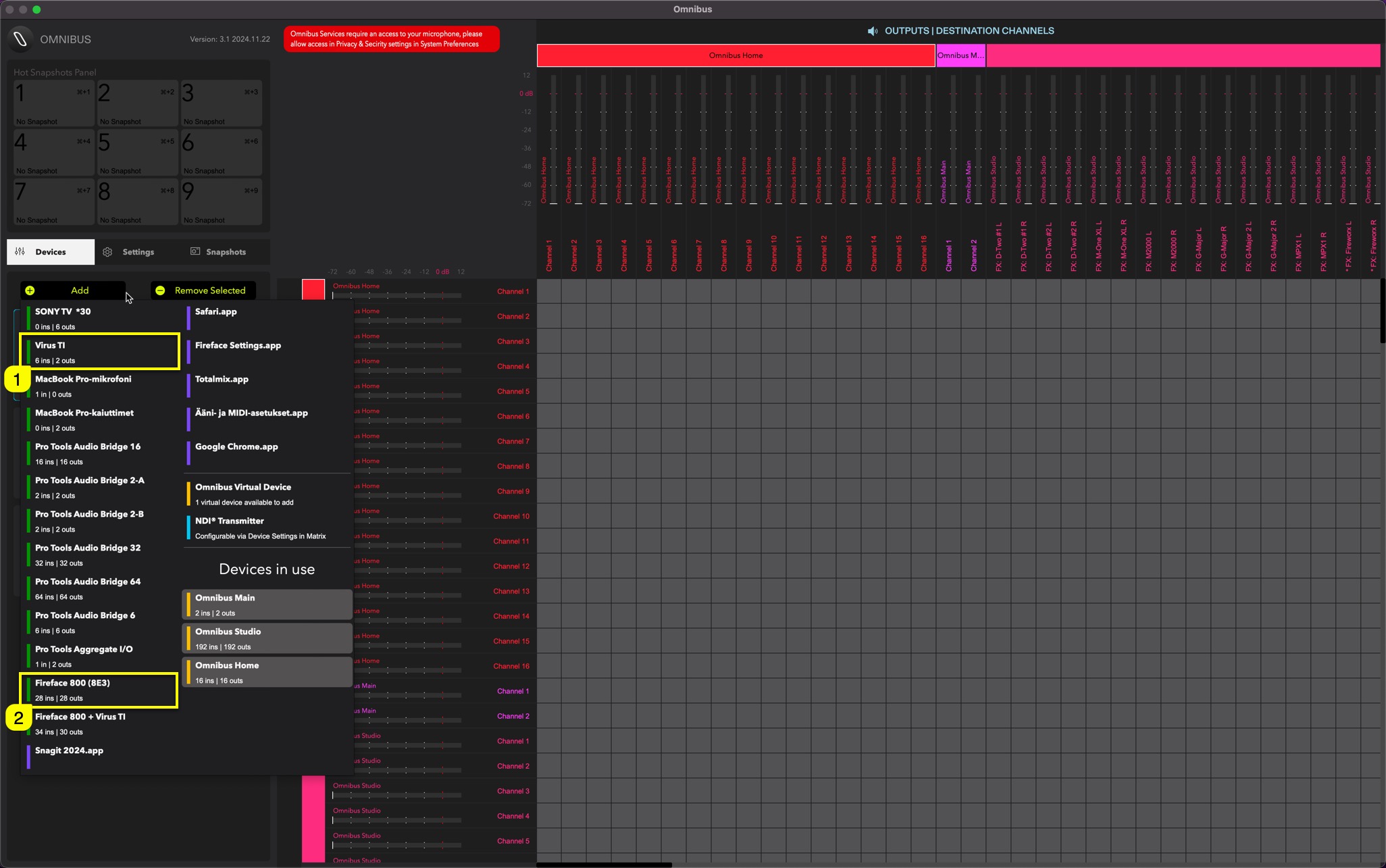
Add Virus TI and additional sources to OMNIBUS
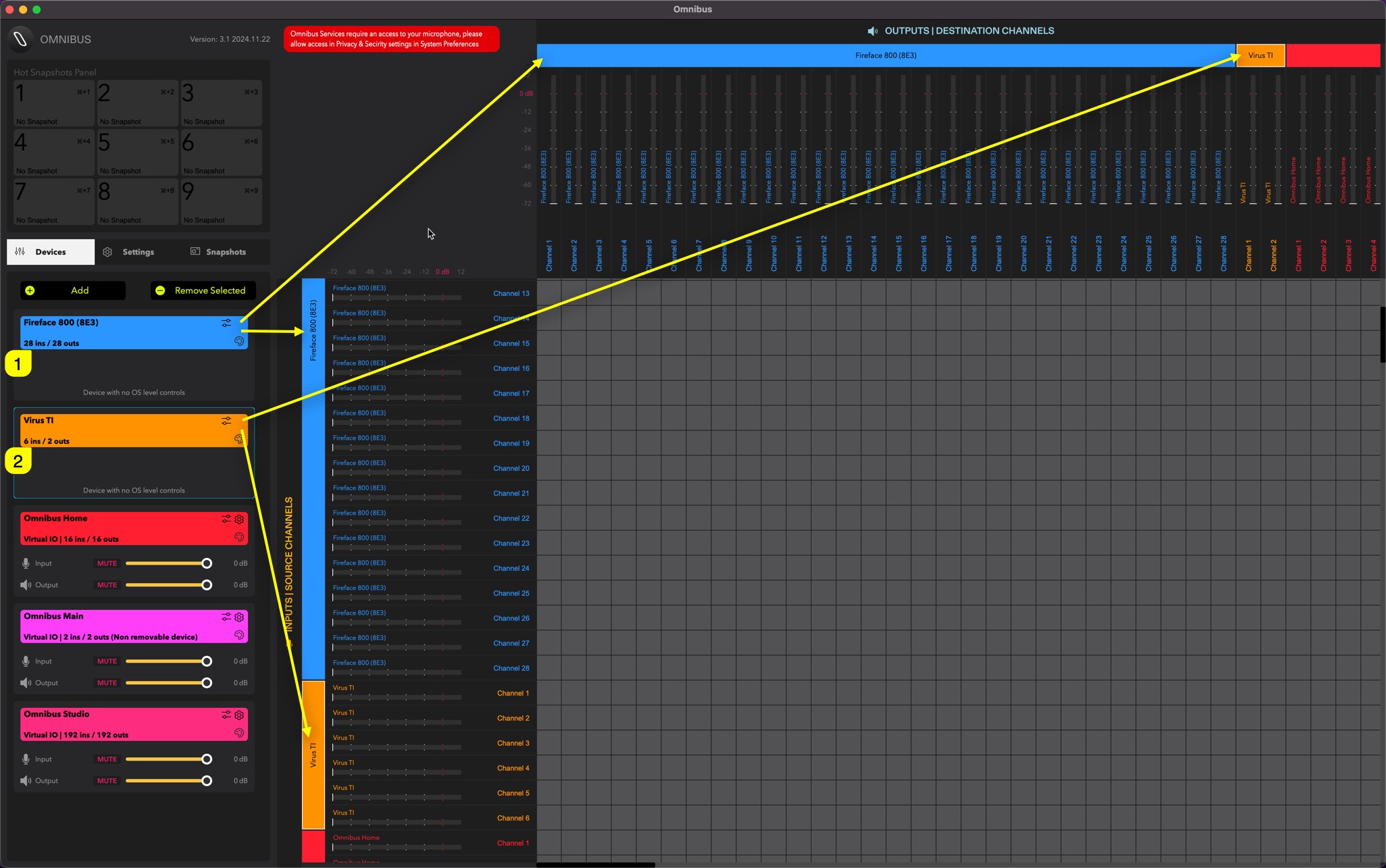
I have Access Virus TI [1] and RME Fireface 800 [2] connected to my mac, so in this example we are going to add both of the devices to the routing.
Like in previous part, click Add button and choose devices you need. Repeat for each device.
Now the Fireface 800 [1] and Virus TI [2] has been added. You can see on the top row we have “OUTPUTS | DESTINATION CHANNELS” and on the left we have “INPUTS | SOURCE CHANNELS”.
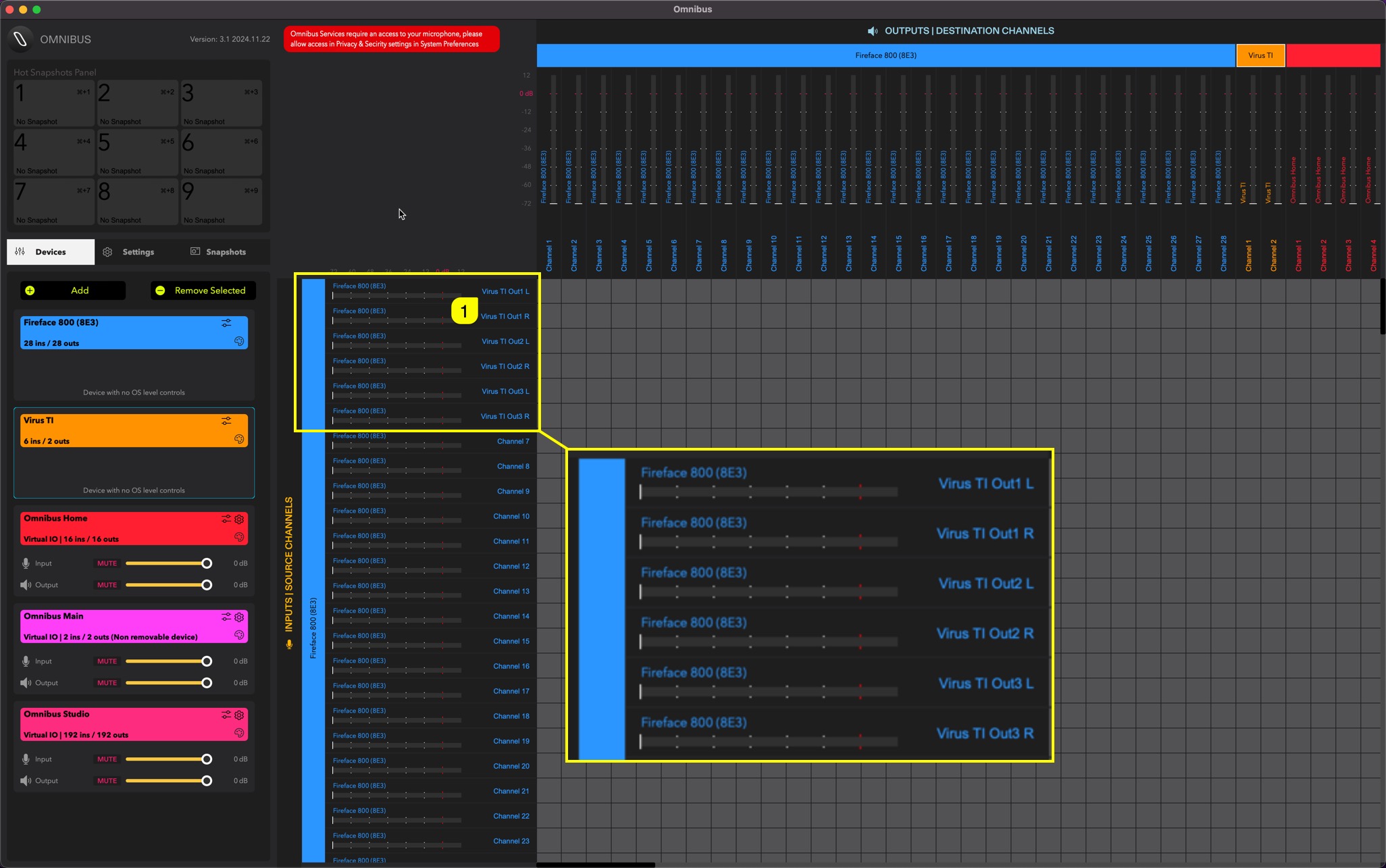
Rename Input Ports
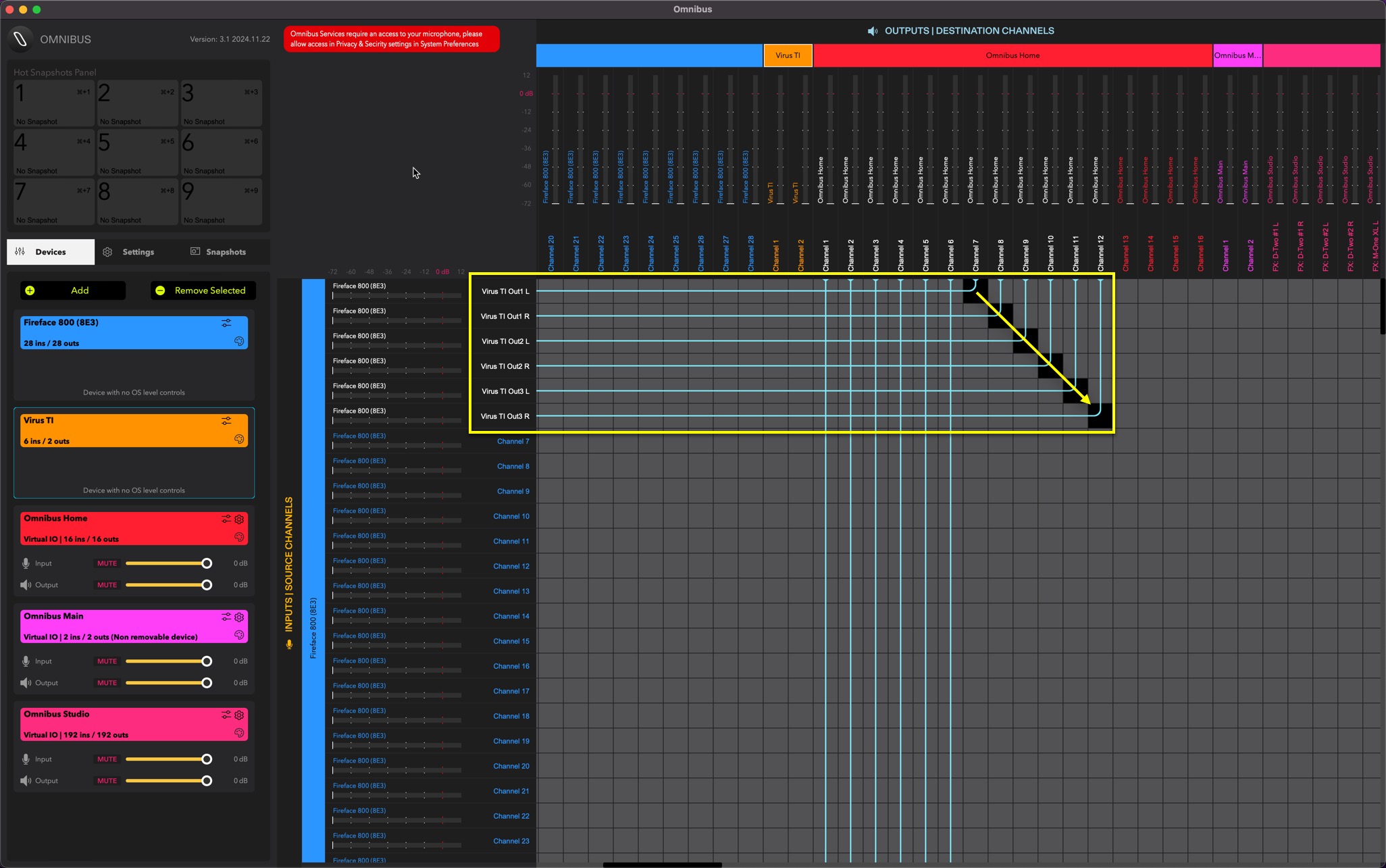
Double click on the input channel [1] name to activate renaming. Fireface 800 inputs 1-6 are my Virus TI analog outputs.
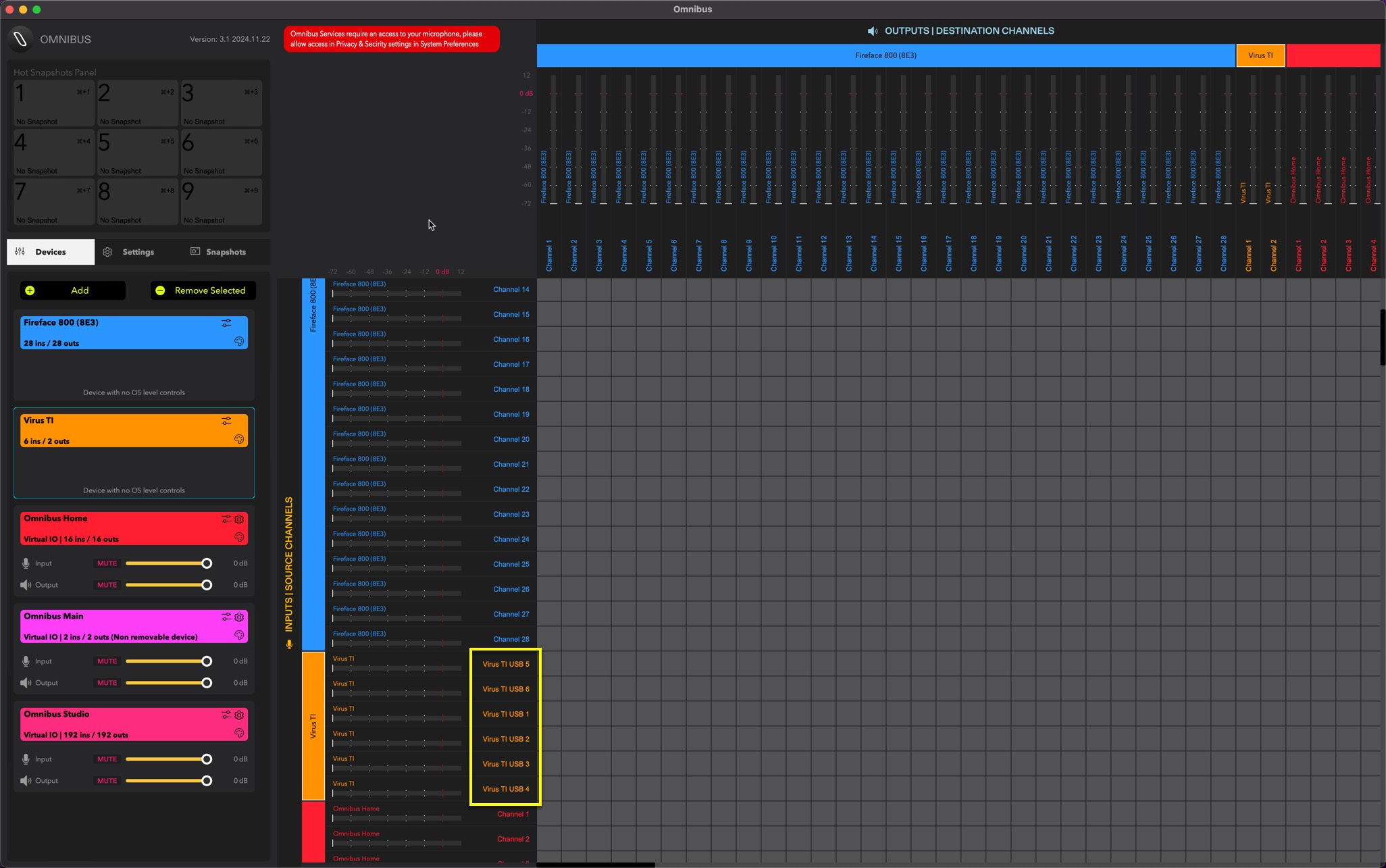
Apply the same for the Virus TI channels, remember, Virus TI outputs are as follows: 5, 6, 1, 2, 3 and 4!
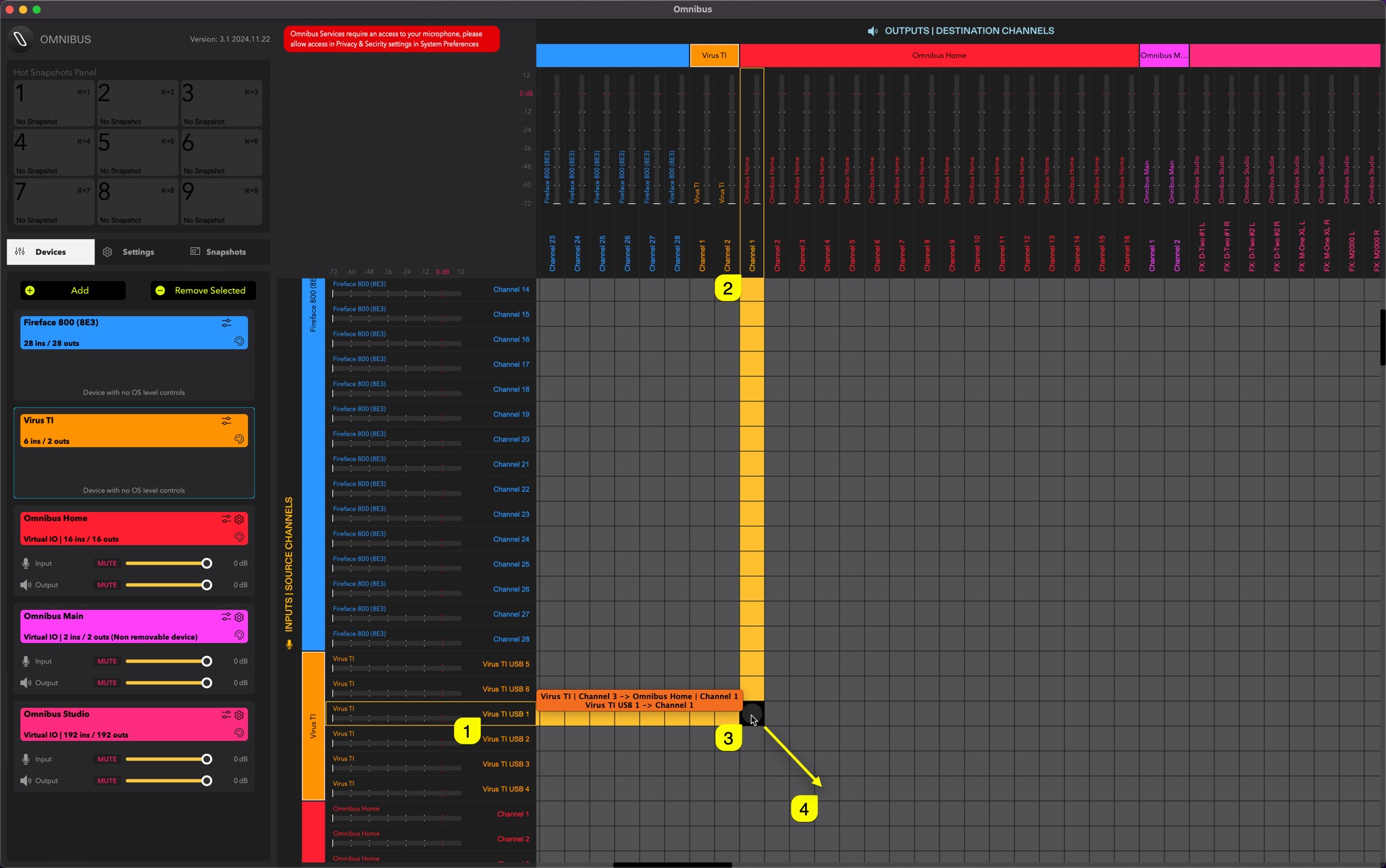
Enter the Matrix
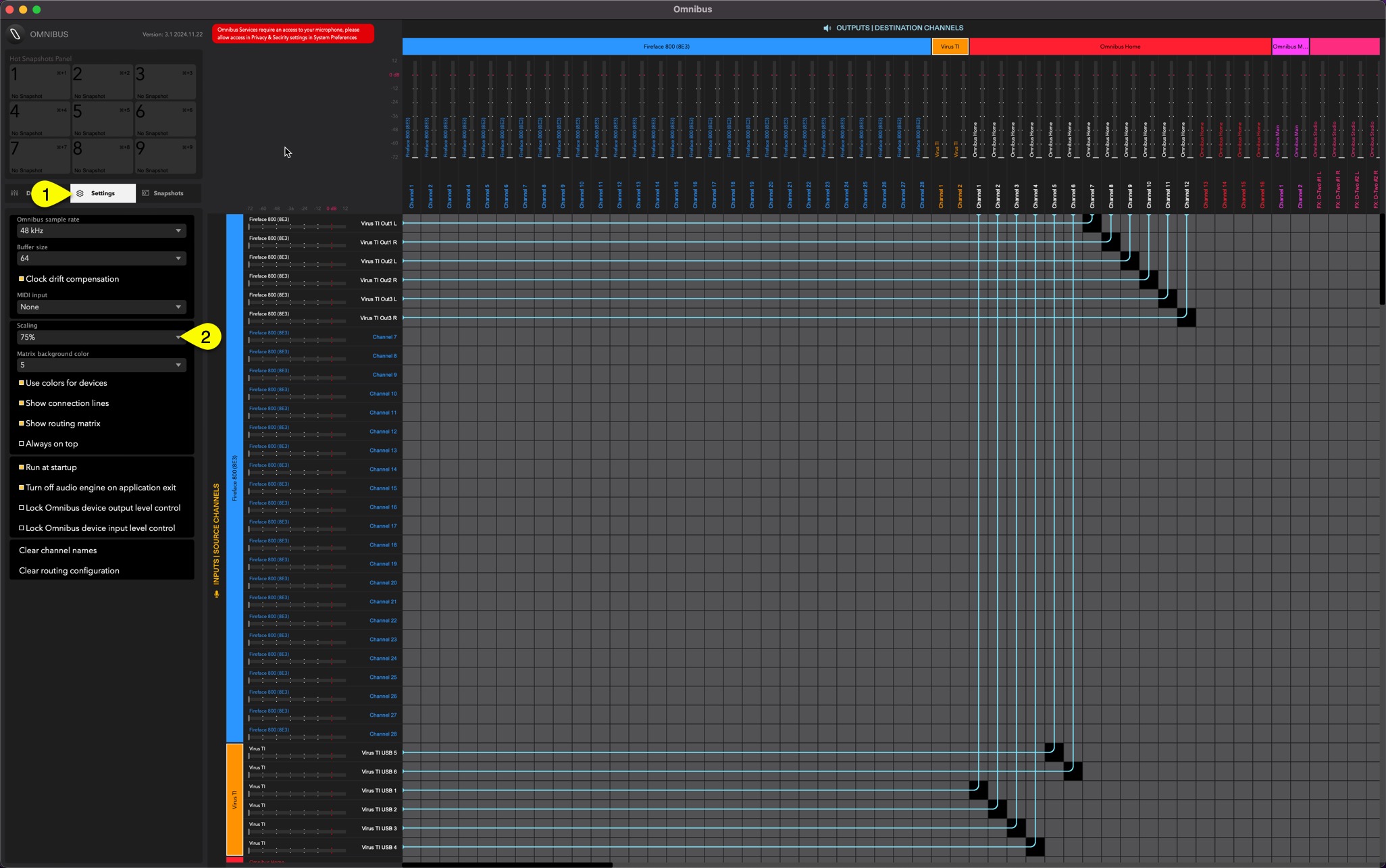
To route audio from Virus TI usb1 [1] to Omnibus virtual soundcard [2], move your mouse to the crossing point [3] of these terminal and click to apply. You can also drag’n’drop multiple connections at once my holding down the mouse and moving along the matrix [4]!
Here is the result for my Virus TI usb connections. Starting from usb1 out to usb6 out, all in order.
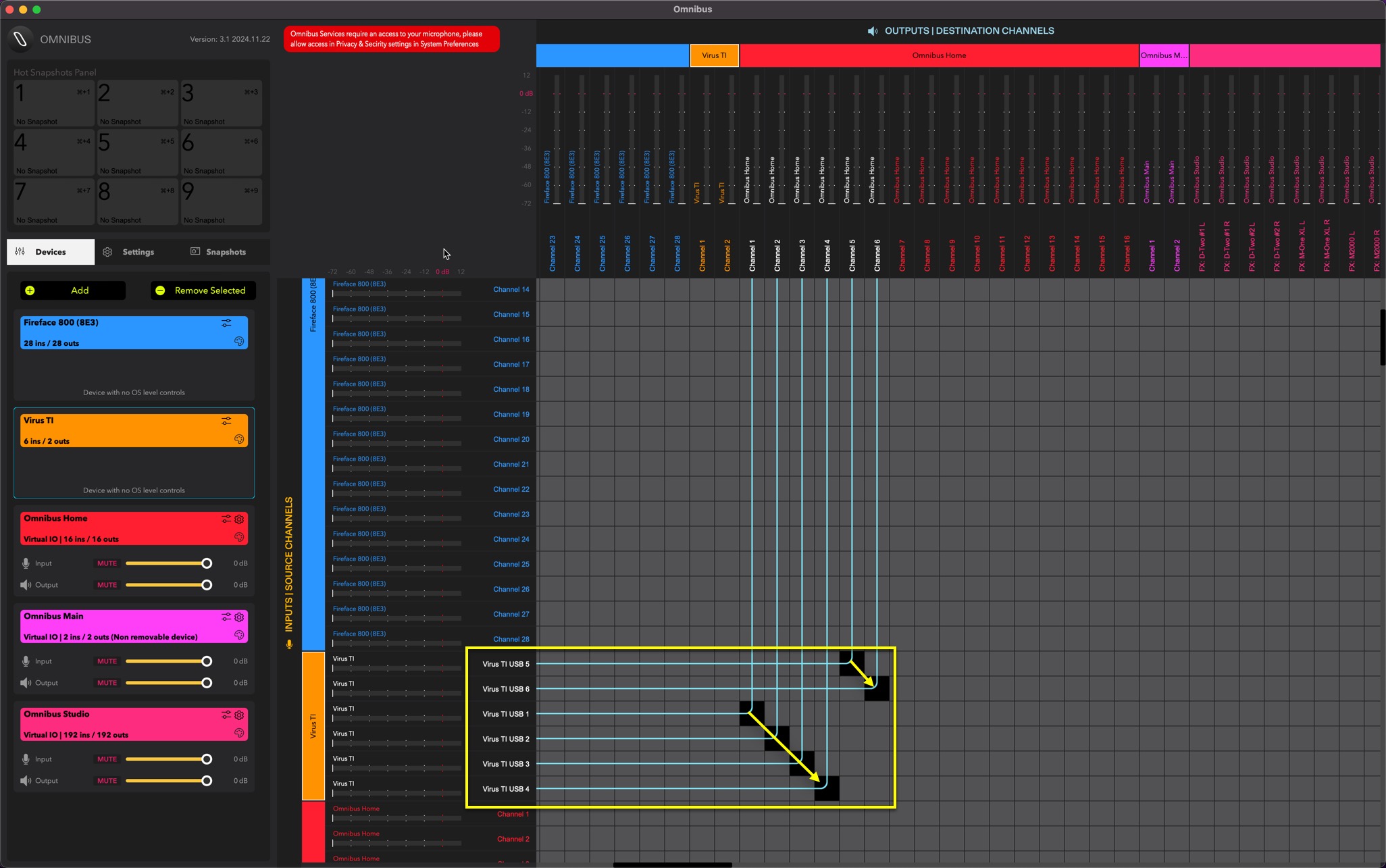
Then this is the result from Analog connection points from Virus TI to Fireface and from Fireface to Omnibus!
If you find it hard to view the connections on your screen, click Settings [1] tab and change the Scaling [2] settings to your needs. At 75% I can view all the routings at once.
Ableton Live and Virus TI USB Audio with OMNIBUS
Selecting the right Audio Devices
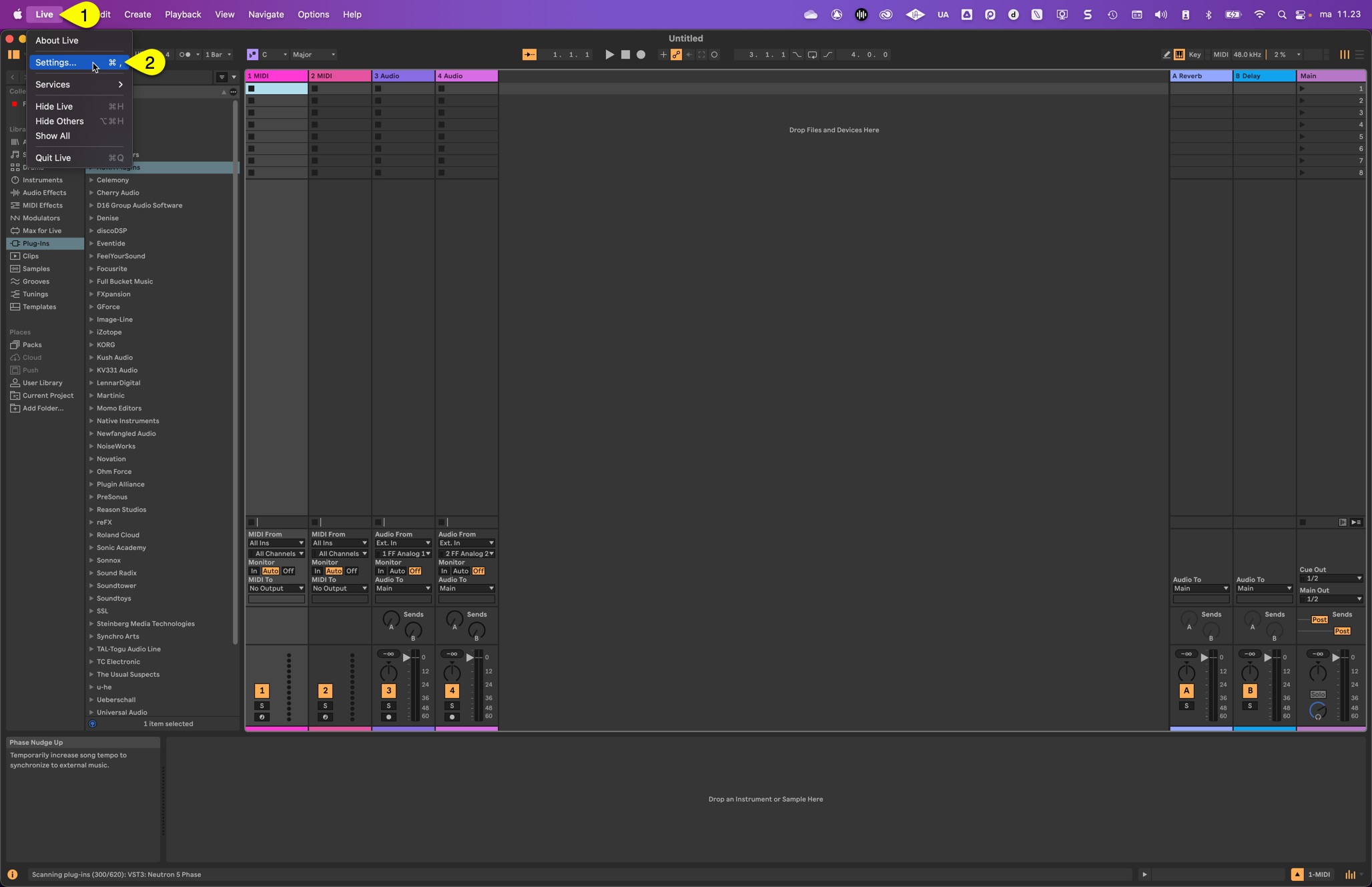
Lets open Ableton Live and set everything up in it. First, click Live [1] menu and open Preferences [2]
Open Audio [1] tab, select the Audio Input Device [2] created in OMNIBUS from the list. I renamed mine as Omnibus Home [3].
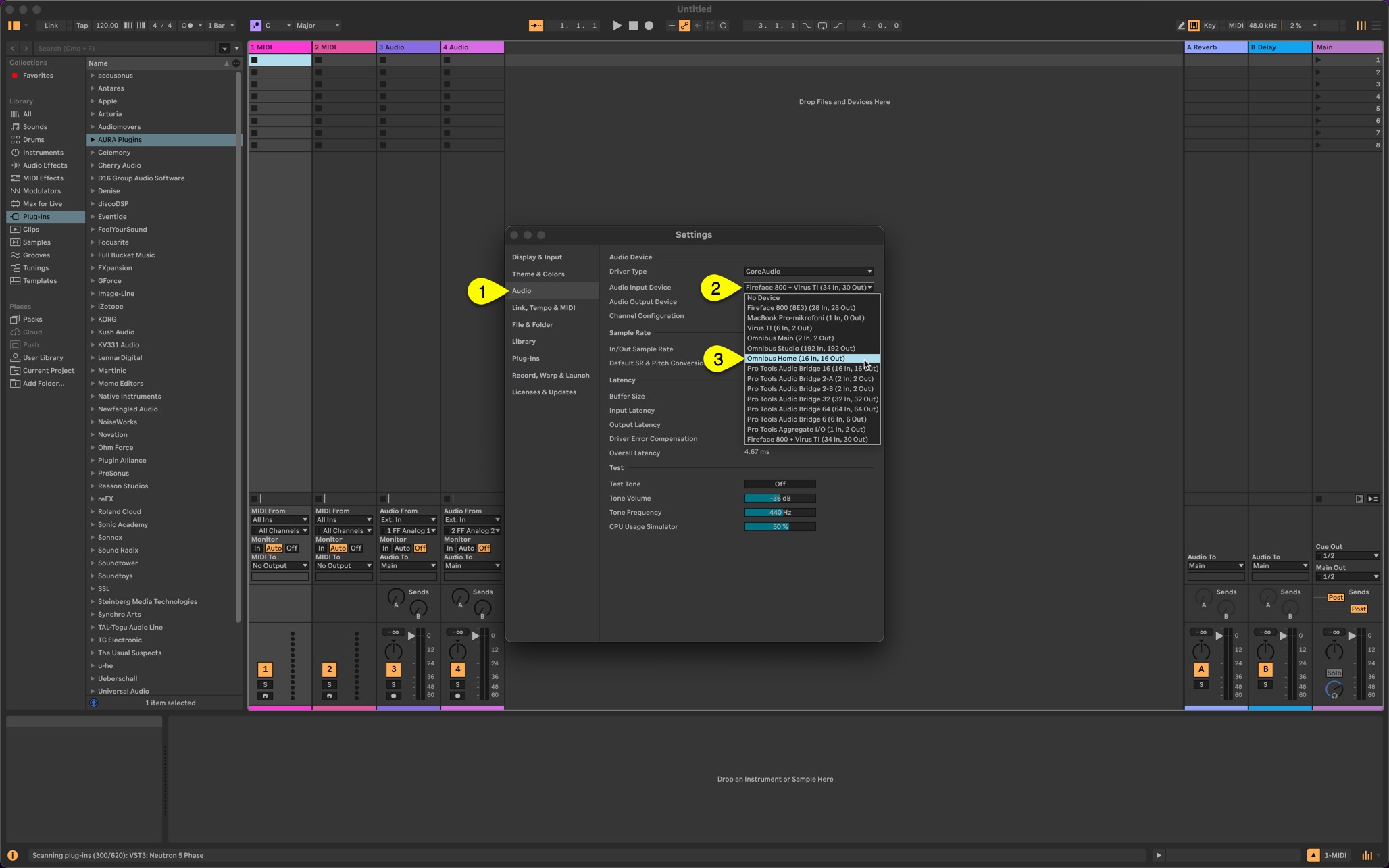
Audio devices are now set: We are using the Omnibus as our input device while the Fireface 800 is the master out device. You can use Omnibus device as your output device too, but you have to route the audio in the Omnibus matrix in order to hear it.
Click Input Config [1] to open the inputs view and enable [2] all the inputs you need.
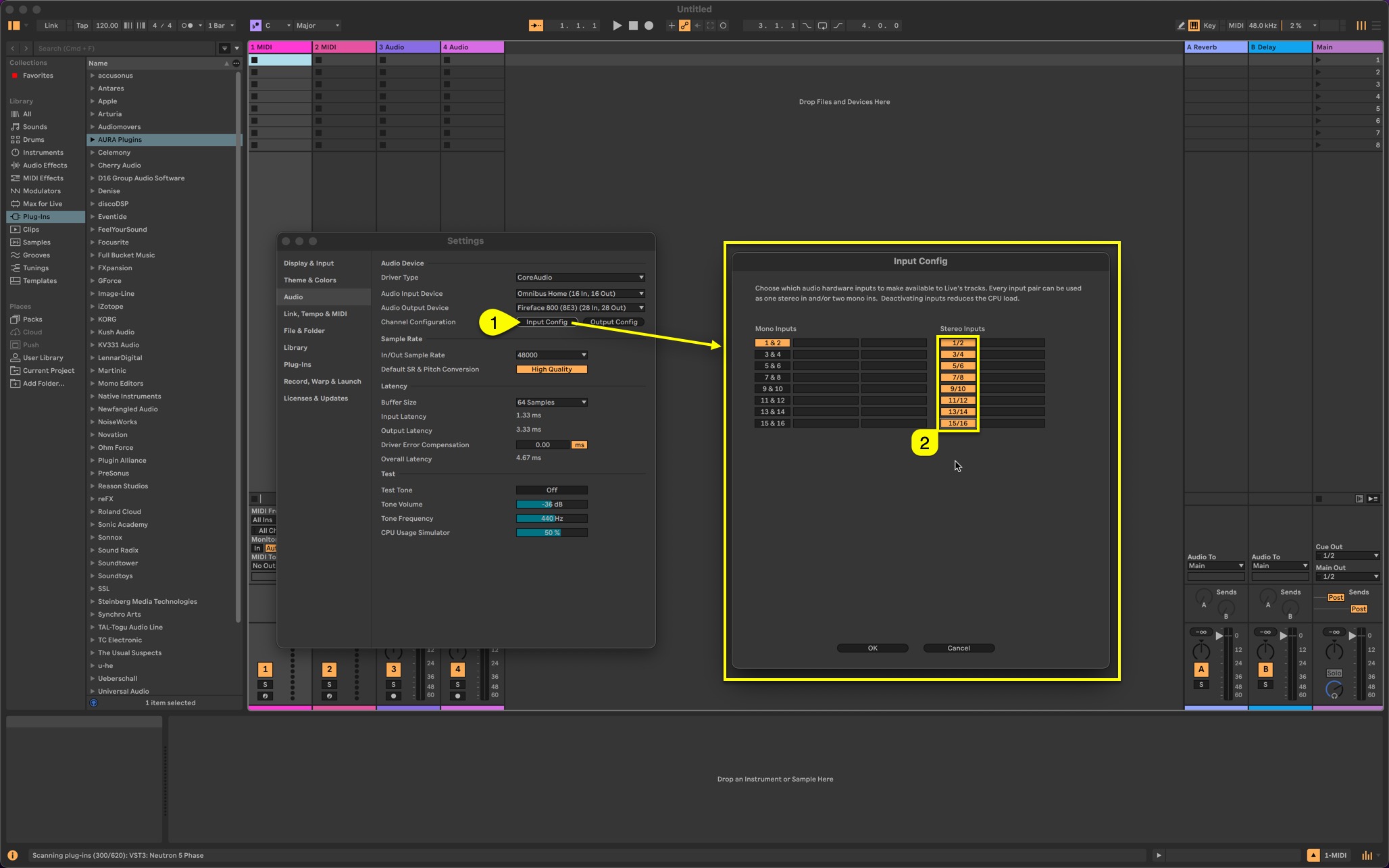
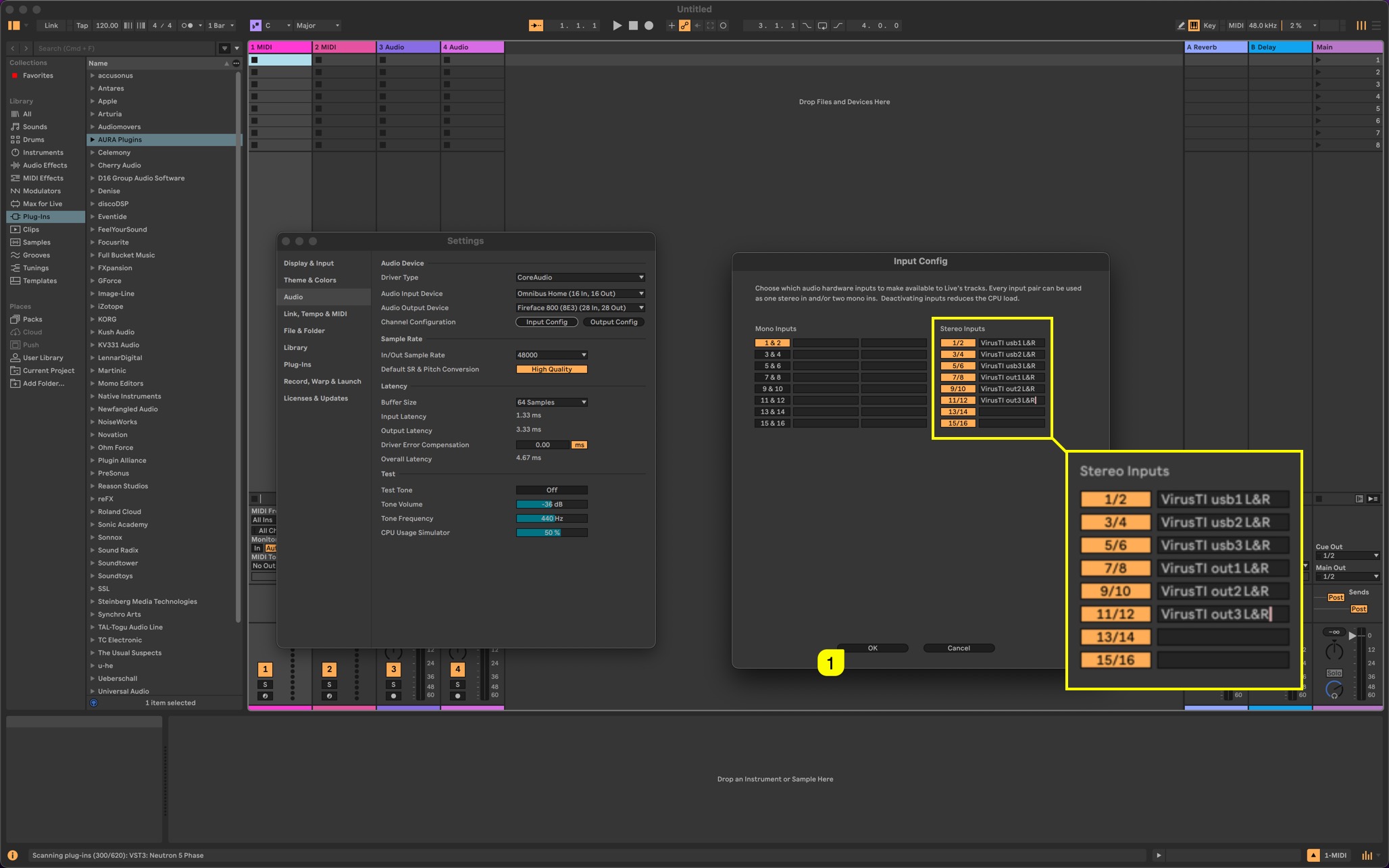
Here is how the inputs look after renaming the ports. These renaming are based on the routings done in the Matrix view earlier! Click OK [1] to close the input config.
Final step before closing the Settings view is to make sure that you adjust your buffer settings [1]. I would personally start with lowest possible value you know your soundcard can handle. I’m setting mine to 64 Samples. Click close [2] toggle once you’re set!
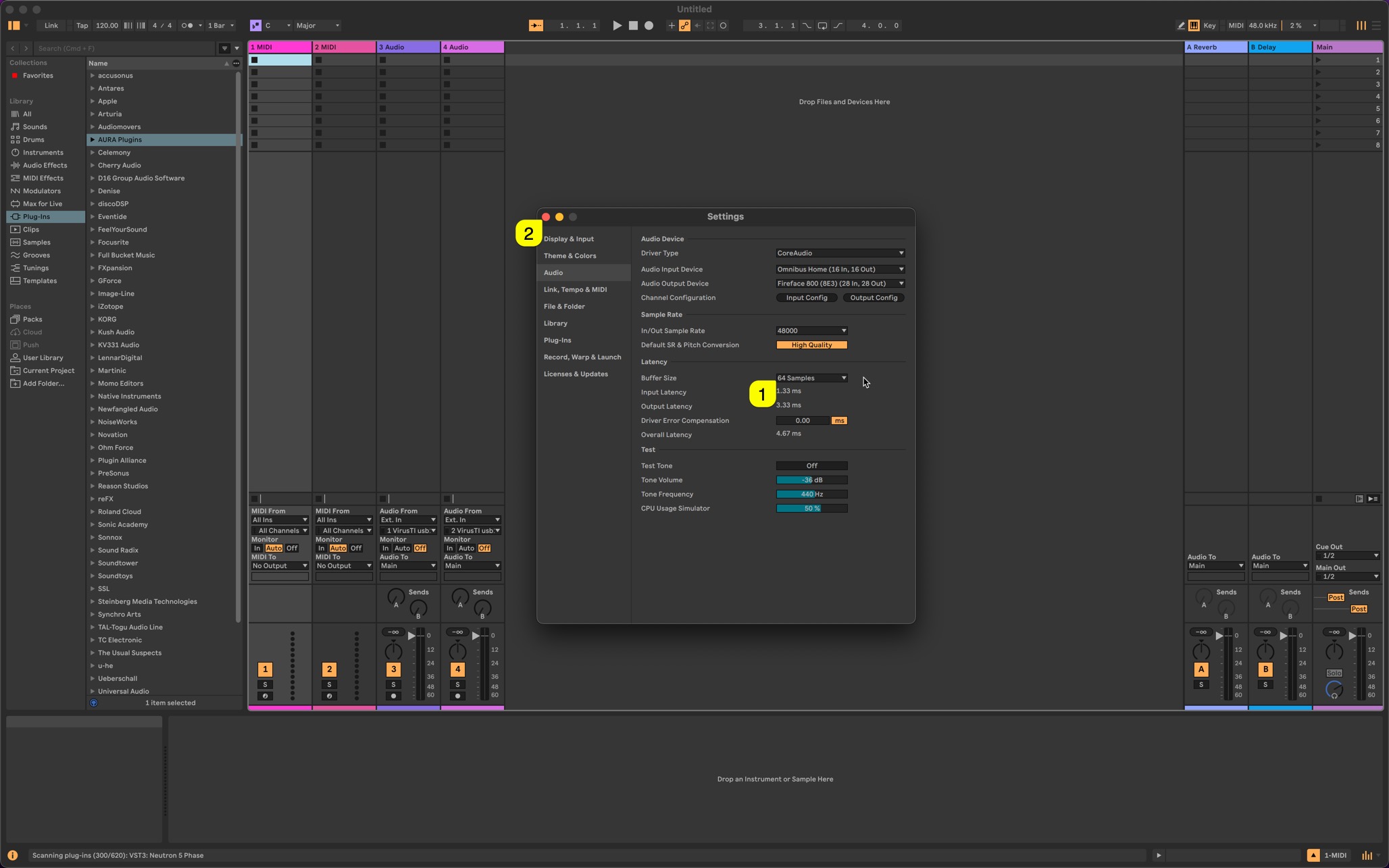
NOTE: If buffer setting is too low or too high, Virus TI USB stream will experience clicks and pops. You have to find a right balance for your setup by testing which works the best.
I personally don’t have any issues running 64 Samples with my M1 powered Mac. In fact, I can easily run 256 inputs in the studio with all channels being enabled for monitoring / recording.
Insert the Access Virus Editor
Lets insert the Access Virus Editor into the project now. We are gonna use Audio Unit since it provides best macOS integration with best stability. VST3 is the worst with MIDI, especially with multi channel configuration.
Drag’n’drop the Editor to Live (we recommend Audio Unit).
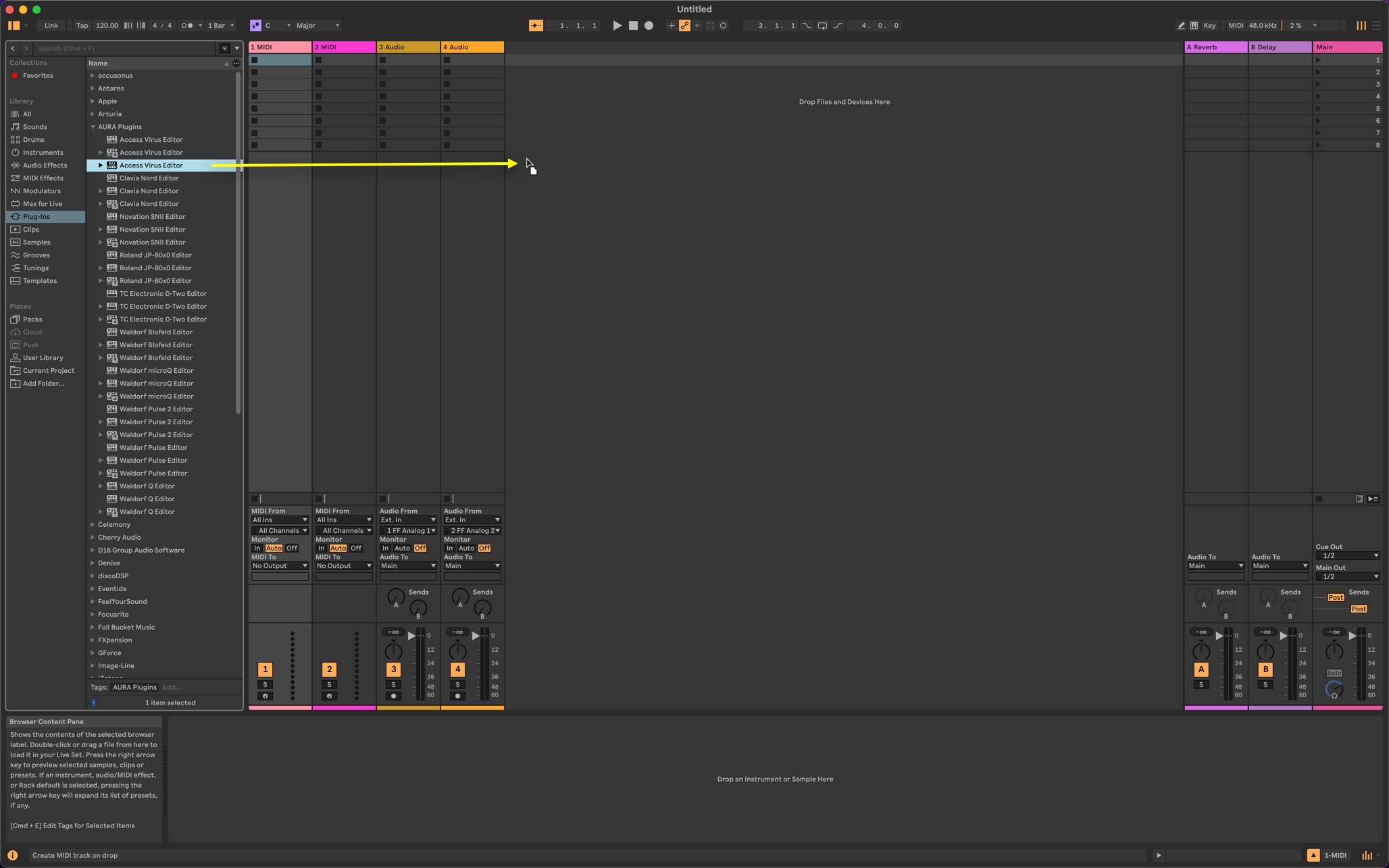
After a few seconds, this will open the Editor user interface.
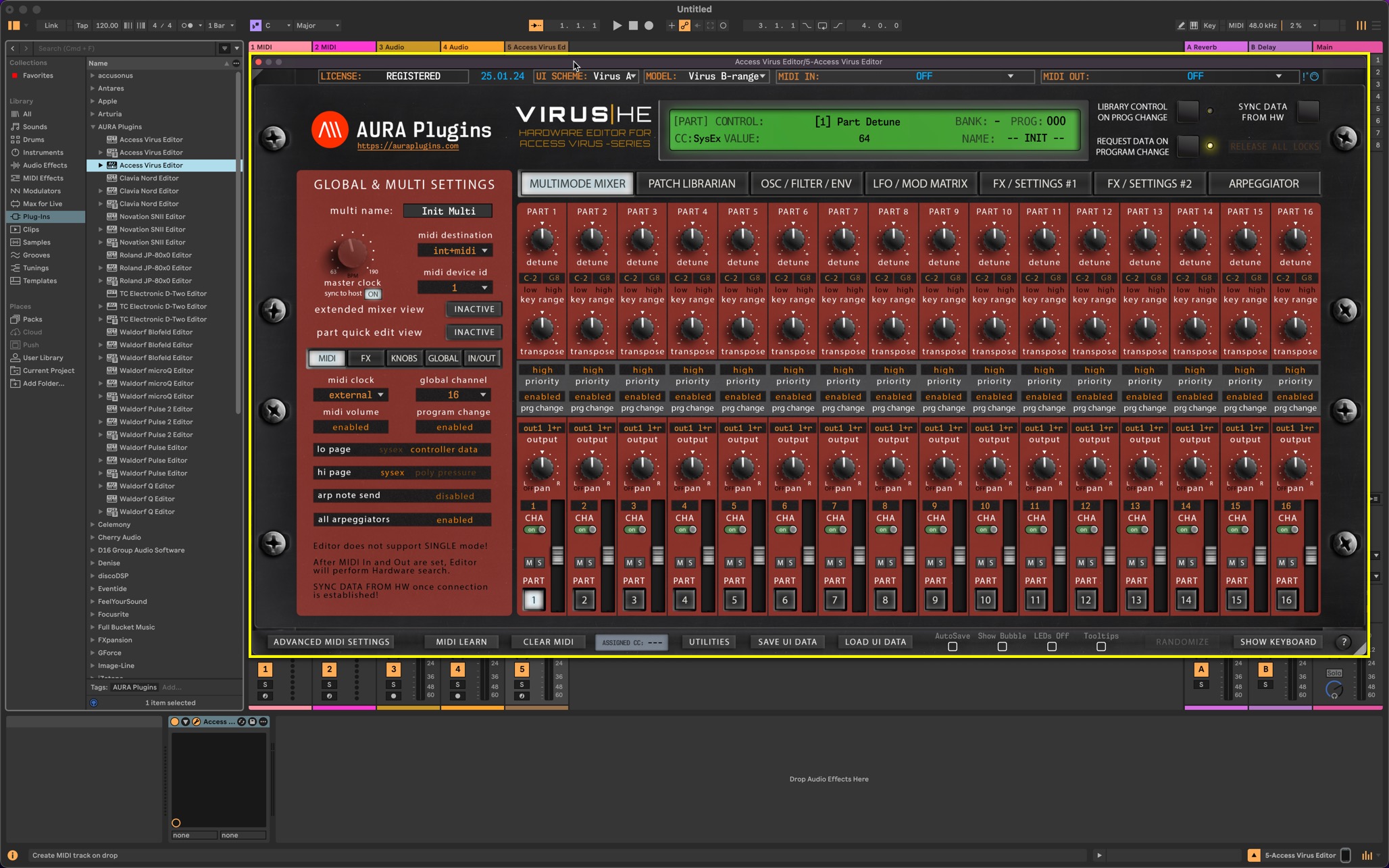
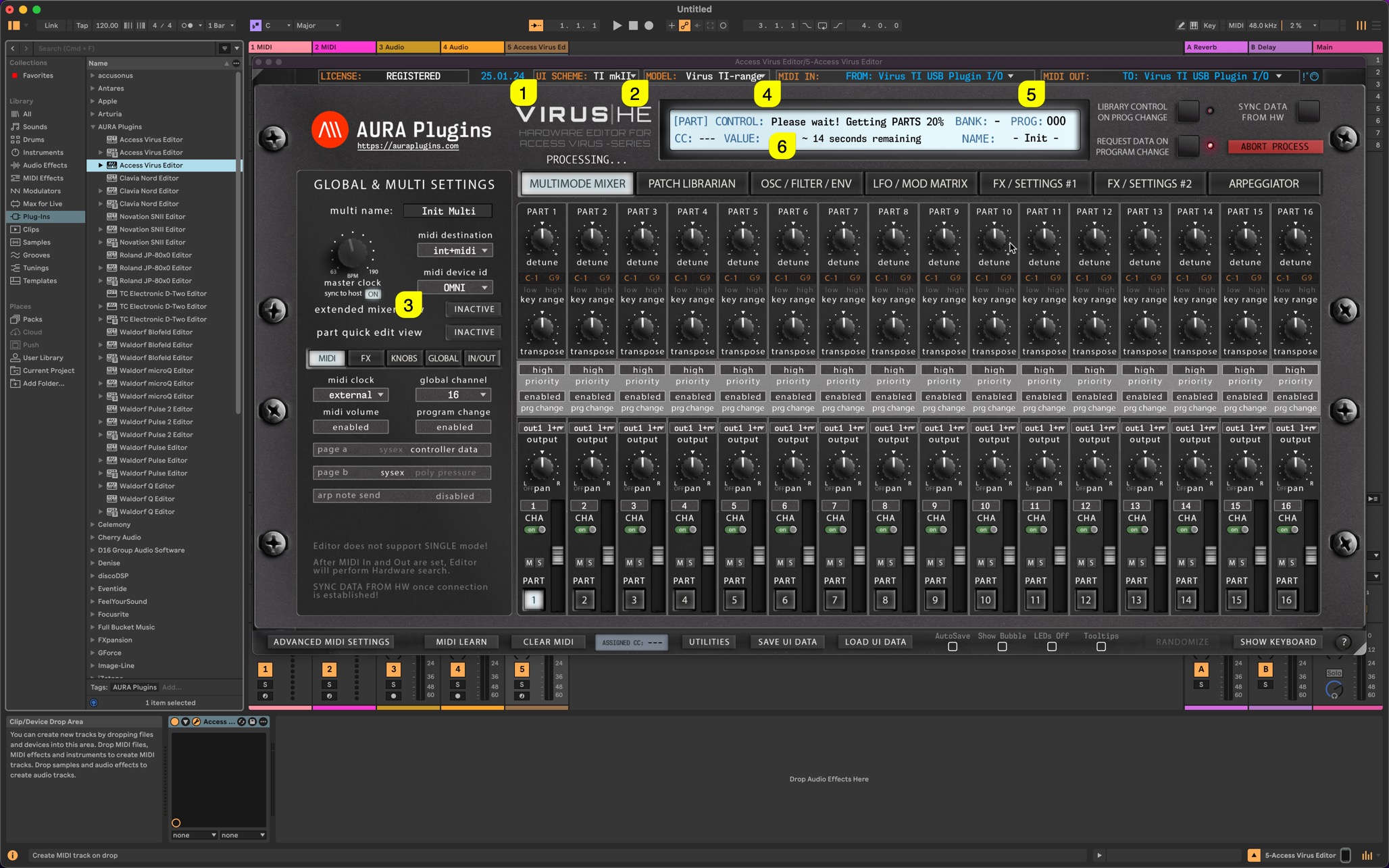
Lets adjust the User Interface and preferences before jumping into loading patches etc:
- 1) set UI Scheme to match your taste.
- 2) set Model to match your Virus TI model (Virus TI-series covers TI and TI2, Virus TI Snow is for TI Snow desktop users).
- 3) check Device ID and ensure it matches your Virus TI Device ID. (we recommend DeviceID 1).
rest of the settings are requested from the Virus once MIDI input and output are set. - 4) set MIDI IN port FROM: Virus TI USB Plugin I/O.
- 5) set MIDI OUT [5] port TO: Virus TI USB Plugin I/O.
- 6) Editor will start automatic sync with the hardware, getting global settings and parts from the Virus to the Editor User Interface. Wait until it’s done.
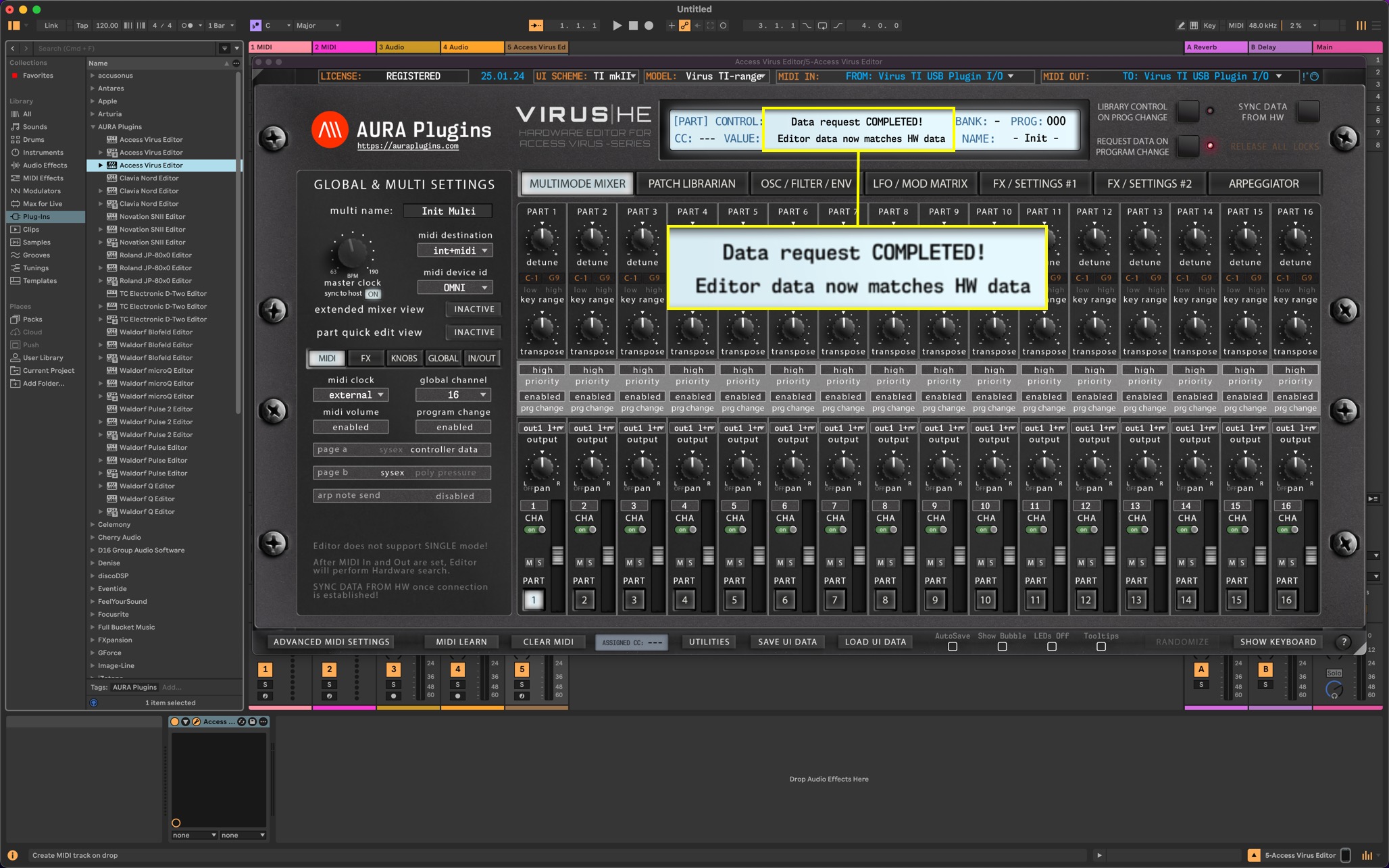
And the final result after the request process has been completed:
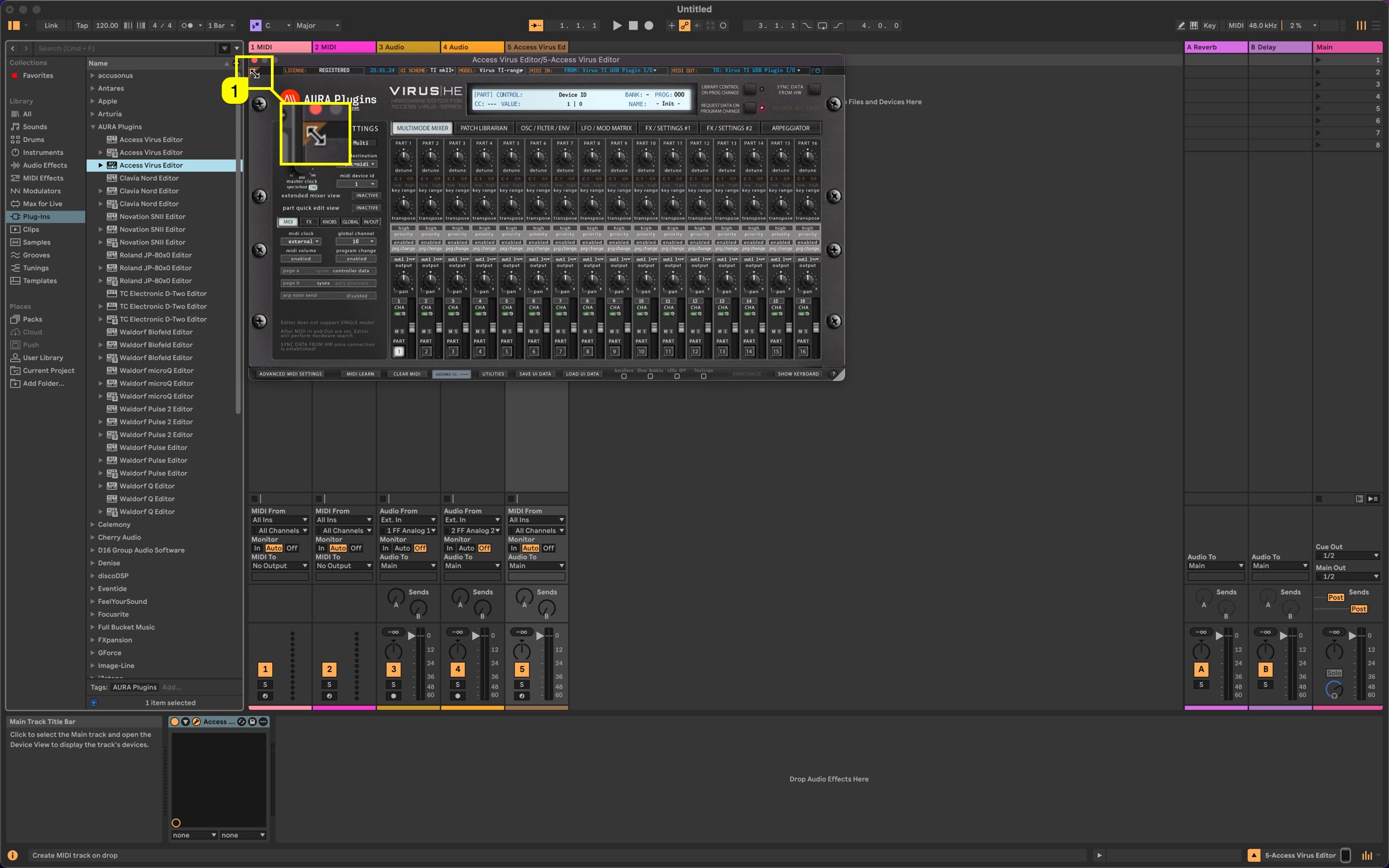
Part 1 of the Editor setup is done, lets minimize the view with left mouse click on the triangle at the top left corner [1] and move to adding Audio and MIDI tracks!
HEADS UP #1: When using USB connection, our Editor works with the Virus TI ONLY via the Plugin I/O ports on macOS. Windows has other options available. We will cover that later on with another article.
HEADS UP #2: External I/O is used for additional gear, like keyboard to trigger DAW or additional sound modules like Novation Supernova II Rack etc.
Create MIDI tracks
To get sample accurate MIDI from your DAW, we recommend to add MIDI tracks for each part used in your session. Our Editor is missing Audio DSP, therefore MIDI output is not compensated which might lead to timing errors.
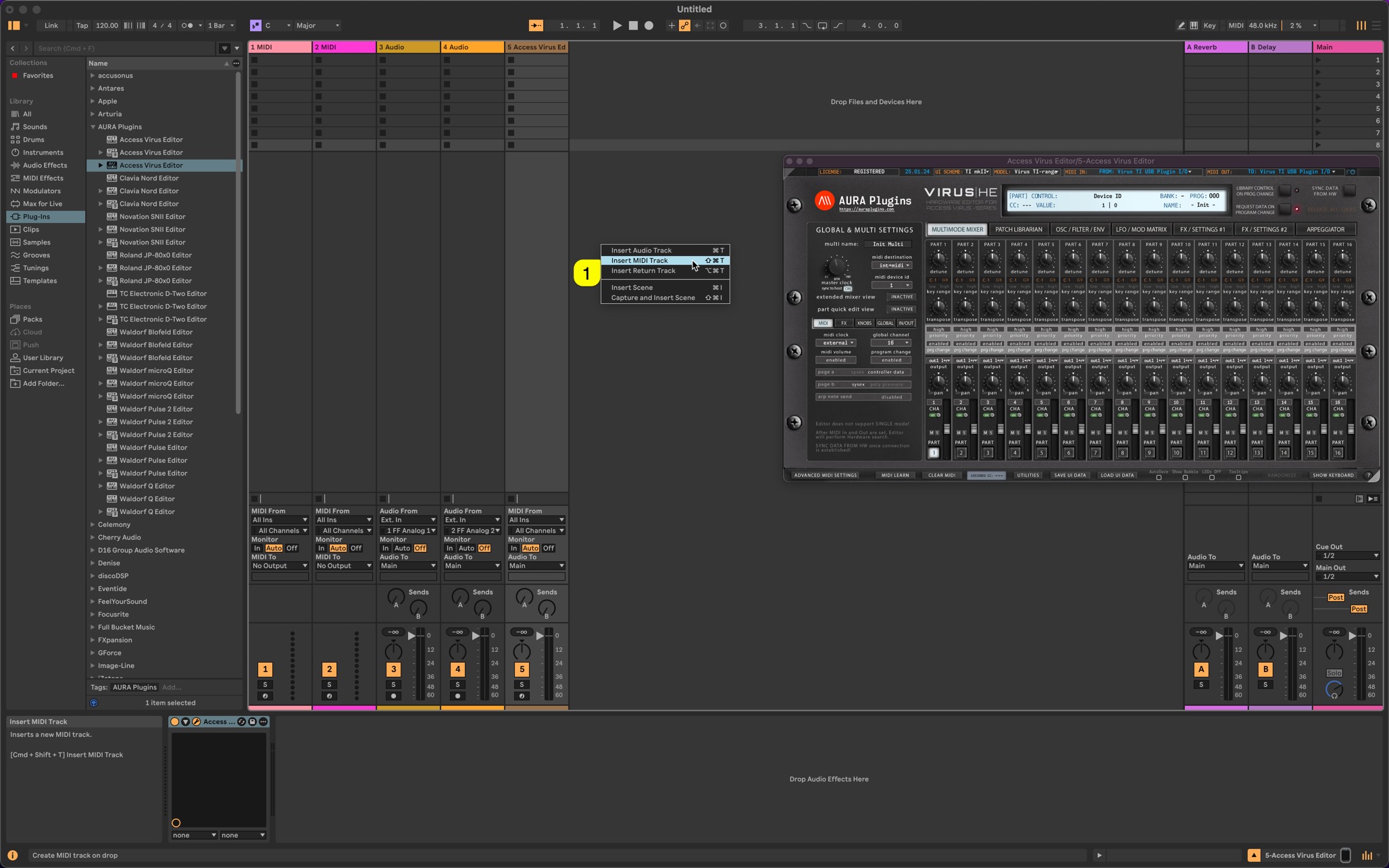
Right click [1] on the Live mixer background and choose Insert MIDI Track or use key command SHIFT + CMD + T. I’ve added 4 tracks for this example – you can add up-to 4 channels with Virus TI Snow and 16 channels with other TI models.
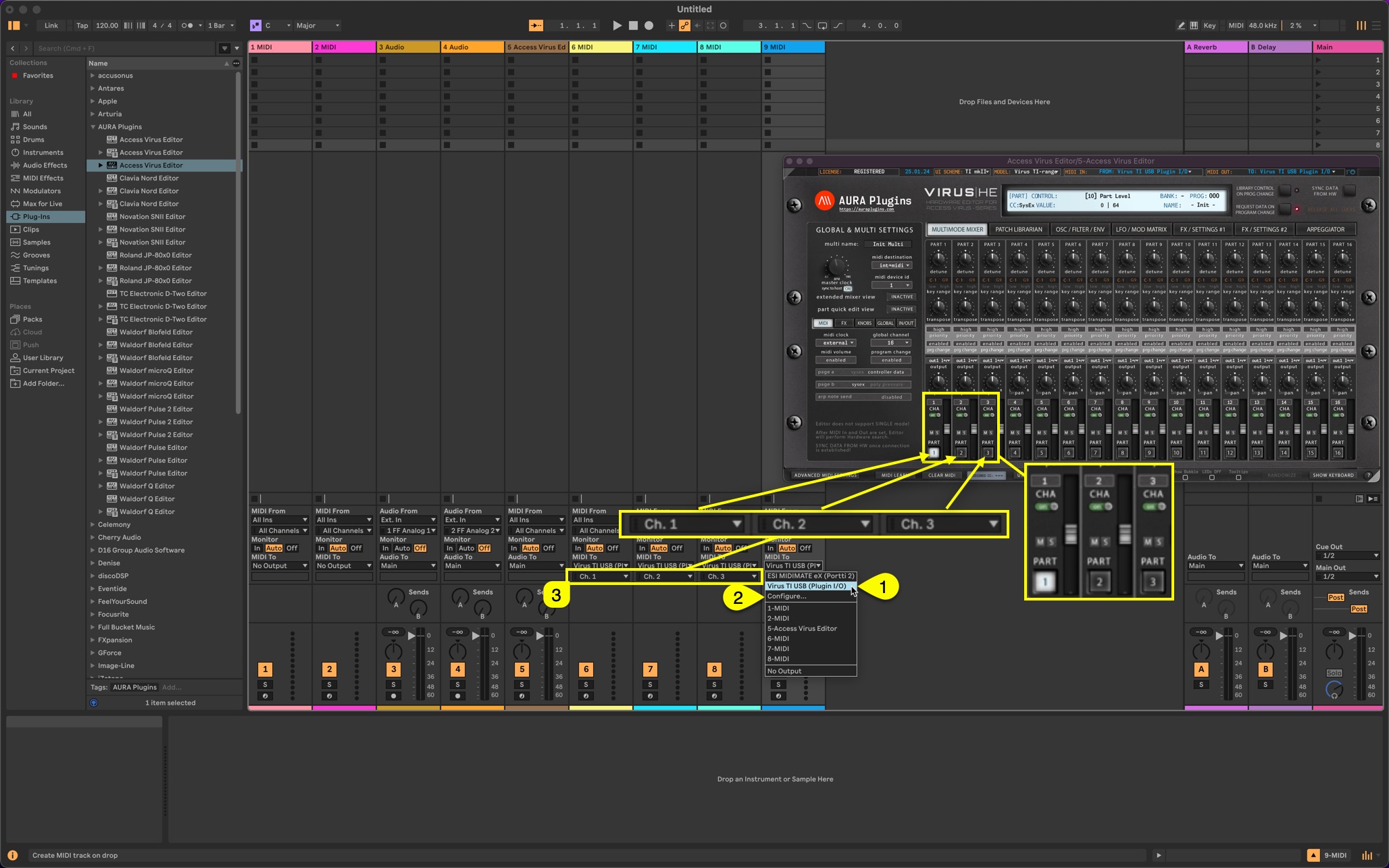
Now assign MIDI To pointing towards Virus TI USB (Plugin I/O) [1] for all channels you’ve created. Next assign each MIDI Track channel [3] to match the Editor/Hardware channels. As you can see from the image below, Part 1 has CHA 1 assigned to it, etc.
If you can’t see the MIDI port in the list, click Configure… [2] and see image further below how to make it visible.
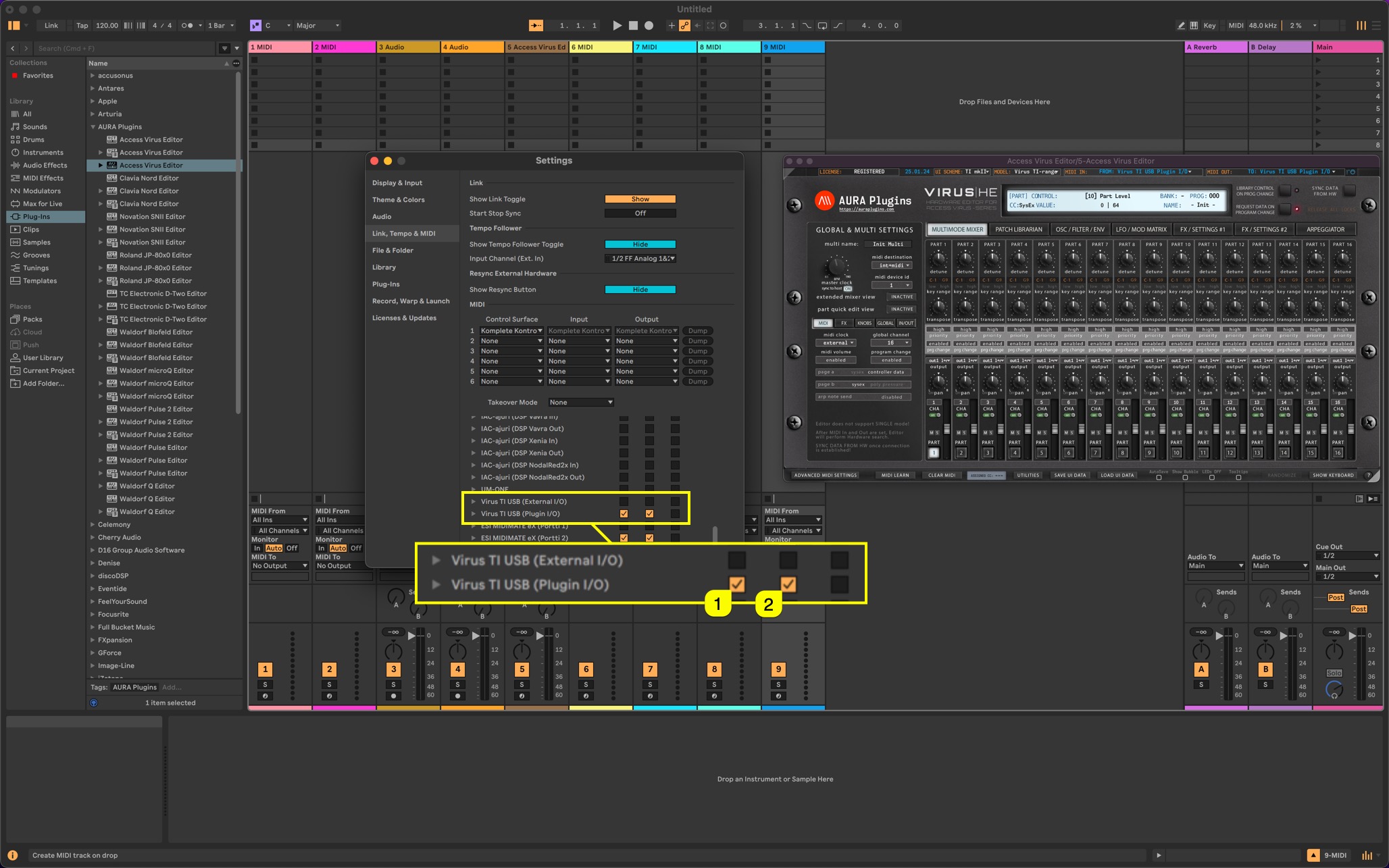
MIDI port configure opens the Settings dialog MIDI settings page. Scroll down the list and Locate Virus TI USB (Plugin I/O). Enable tracking [1] and sync [2] for the port and close the window. Now the port name is visible in Live.
NOTE: After Initial sync is done with the Virus TI, you should double check the MIDI channels per parts. Virus TI doesn’t transmit the channel settings back to the Editor User Interface when Sequencer mode is toggled on.
Create Audio tracks
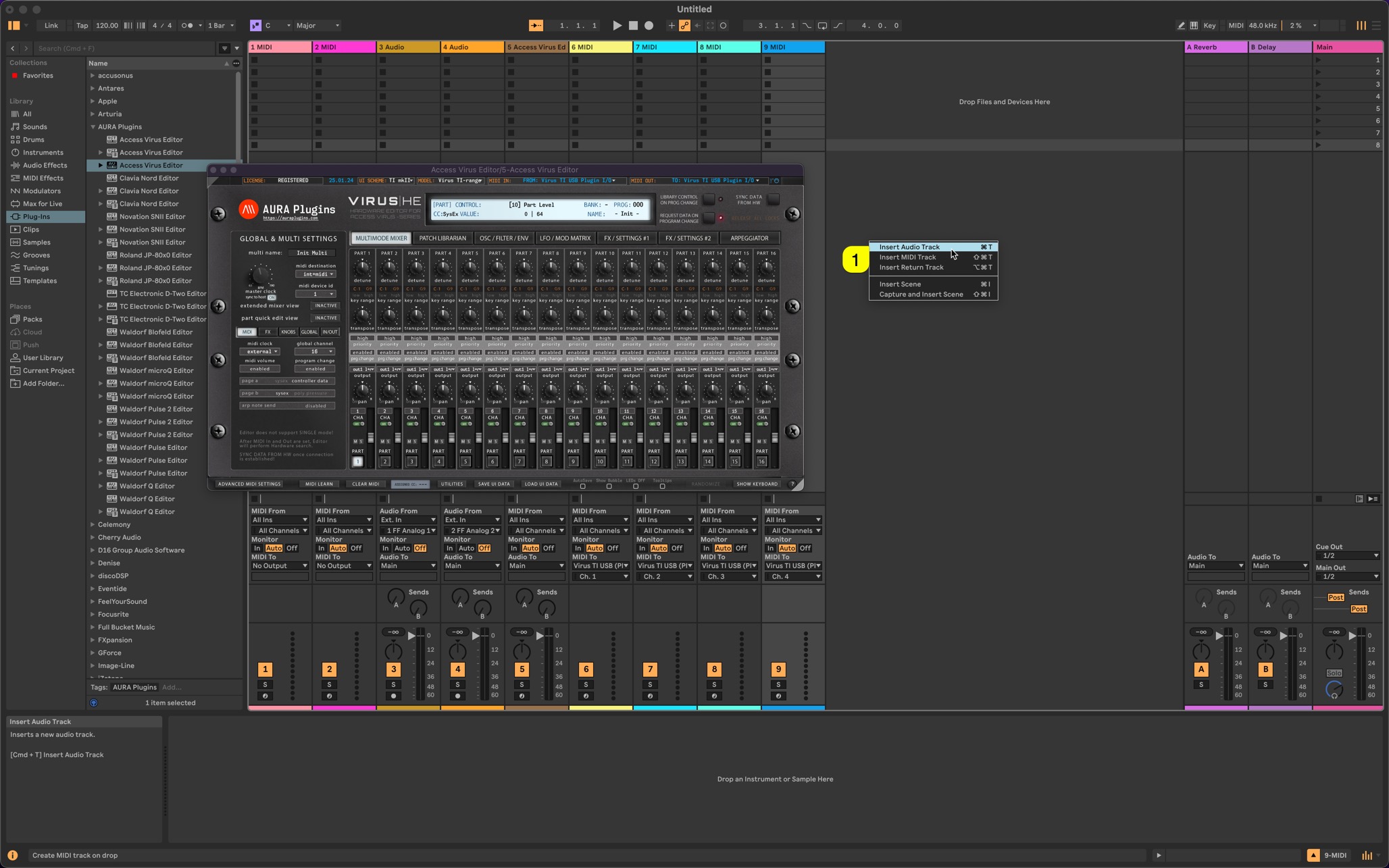
Right click [1] on the Live mixer background and choose Insert Audio Track or use key command CMD + T. I’ve added 6 tracks for this example – if you use USB only, then you can add 3 tracks – I’m combining USB + Analog Outputs.
Assign Inputs [1] in the mixer view. Audio 10 has inputs 1/2 VirusTI usb1 L&R etc. After you’ve assigned all the inputs, toggle on Input Monitoring [3] to hear the Audio from the Virus TI once notes are triggered. Audio 13 – Audio 15 input ports [2] are my Virus TI analog outputs.
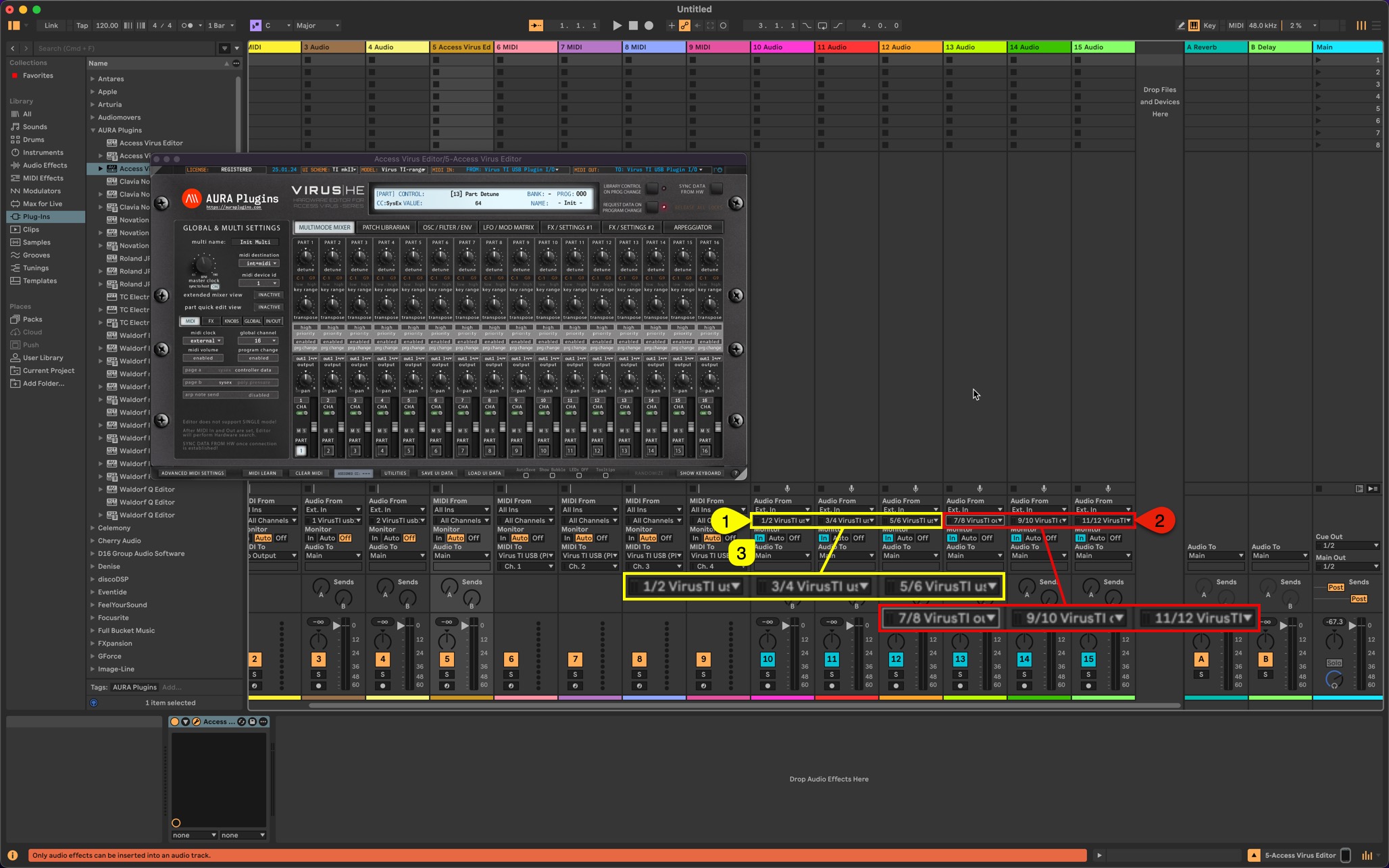
Now the final step is to MAKE SURE THAT THE EDITOR PART OUTPUT is routed to USB 1, USB 2 or USB 3 in order to hear the Audio!
In the Editor window, double click the triangle in the top left corner to enlarge the User Interface.
Now open output [1] dropdown for each PART and select your desired output. usb1-usb3 outputs [2] are listed at the bottom, while analog outputs [3] are listed on the top.
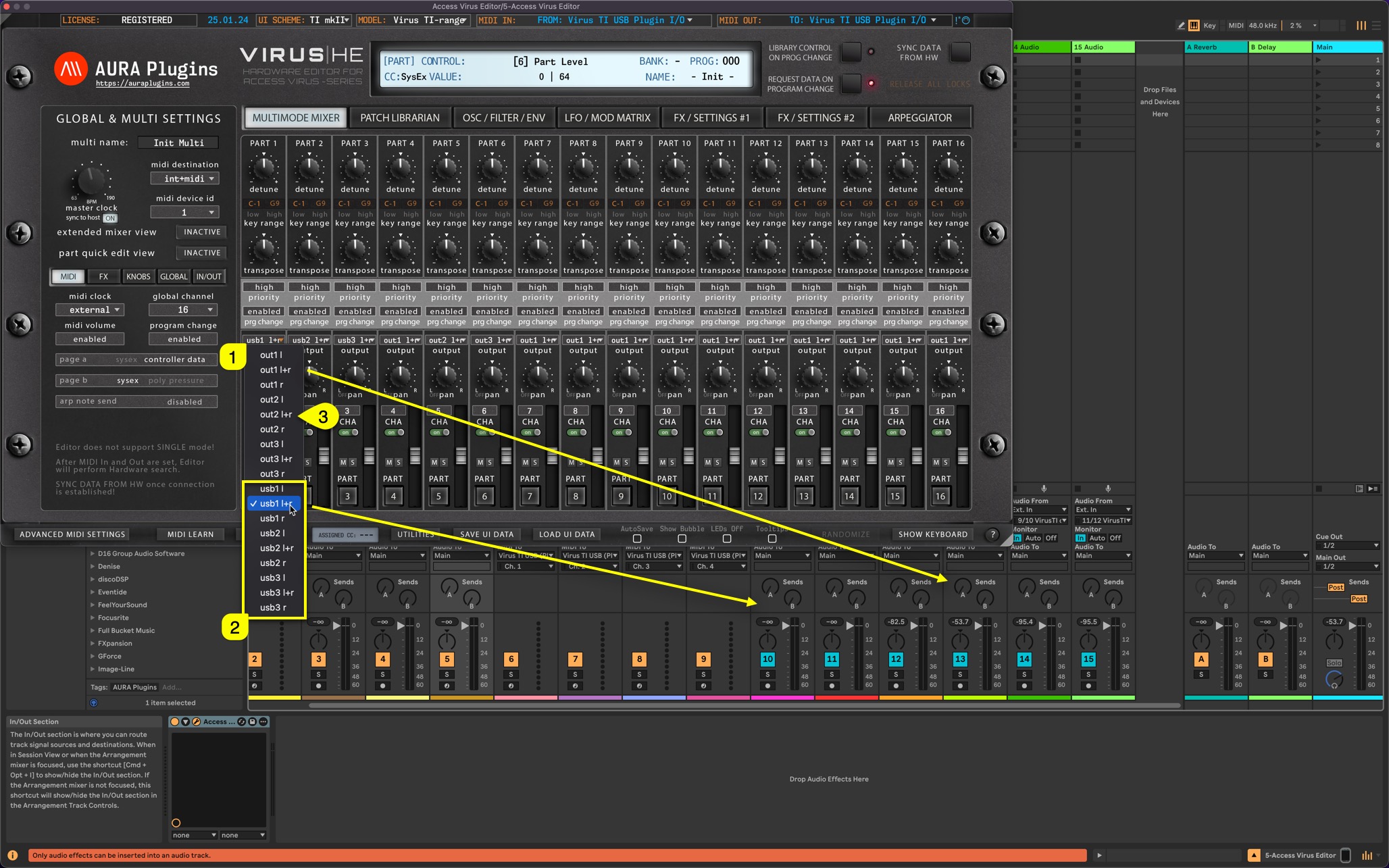
USB outputs from Virus TI are now routed to tracks 10-12 while Analog outputs are routed to tracks 13-15.
Now select a MIDI track you assigned for Virus TI and start playing! Make sure you have Input Monitoring enabled [1] for the specific MIDI track to send the notes to the hardware. In this last screenshot, we can follow the signal path as follows:
2) MIDI from Live tracks 6-9 is assigned to Editor / Hardware Parts 1-4.
3) Audio from Hardware is assigned to Audio tracks 10-15 with Input Monitoring enabled.
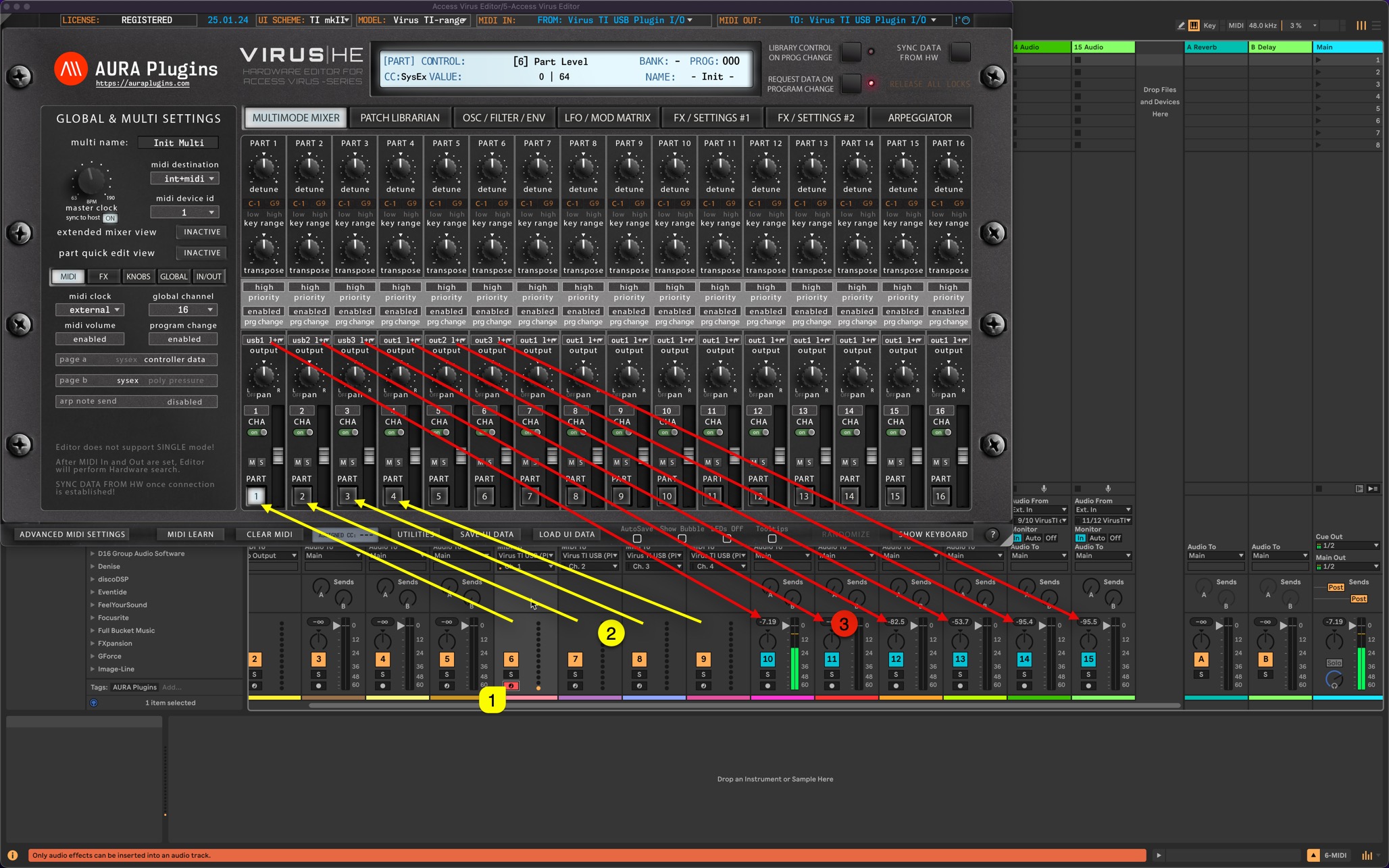
This is it! Access Virus TI USB Audio with OMNIBUS is working! It is really simple once you get it going – You can save the template after everything is configured, but keep in mind that you should check and make sure the Virus TI is enabled before you start your session.
Conclusion
Audiomovers OMNIBUS is a perfect tool for those who wants to stack multiple interfaces together or make virtual routings inside their DAW. Adding Virtual device with Virus TI in it (and some additional interfaces in our case) was simple.
Caveat is that the Virus TI USB connection can get “killed” when the synth is powered off and the synth communication is VERY slow, especially when data is being requested from the Virus TI to the Editor.
Data flowing out from the Editor to Virus TI works out just fine.
Checkout our Access Virus Editor and spread the word – Its been a long road.
Access Virus Editor Product page (requires Access Virus synthesizer or DSP56300Emulator with Virus OS) (DSP56300 Setup Guide is coming soon!)
Access Virus Editor Downloads page (logged in customers can see full downloads, guests can see demo downloads).
Audiomovers OMNIBUS: Amazing tool for making insane routings inside your macOS & PC.
Learn more about Omnibus: https://audiomovers.com/products/omnibus
Return to Virus TI USB Audio connection article
Share this with fellow producers